
Hardwood Flooring in Long Grove, IL
That Lasts a Lifetime
Plamada Flooring delivers expert hardwood flooring installation, refinishing, and repair to Long Grove homeowners. We bring over seven years of hands-on experience to every project — from single-room upgrades to whole-home transformations. Free estimates. Responses within 48 hours.
What Does Hardwood Flooring Installation in Long Grove, IL Actually Involve?
Plamada Flooring handles hardwood flooring installation in Long Grove from the moment our crew arrives through the day you walk on a finished floor. Long Grove homes present specific conditions — established construction, varied subfloor types, multi-room projects that require careful sequencing. Our process is built around those realities, not a generic checklist designed for cookie-cutter builds. Every step below reflects what actually happens on your job site.
What Is Our Installation Process From Subfloor to Final Finish?
- 1Site Inspection & Moisture Testing
We inspect the installation area and use a moisture meter on the subfloor before any material is ordered. Moisture readings determine whether the space is ready for installation and which products are appropriate for your conditions.
- 2Subfloor Evaluation & Preparation
We check for high spots, soft spots, squeaks, and levelness issues. Any problem found here must be corrected before boards go down. Skipping this step causes buckling and squeaking after installation — we do not skip it.
- 3Hardwood Acclimation
Hardwood boards sit inside your Long Grove home for two to seven days before installation begins. Illinois temperature swings between dry heated winters and humid summers mean wood stored in an uncontrolled space will move after it hits your living conditions. Acclimation prevents that.
- 4Layout Planning & Expansion Gap
We plan the direction of run for each room and mark expansion gaps at all walls and fixed objects. These gaps allow the wood to move with seasonal humidity changes without buckling. They are covered by baseboards and transition pieces — invisible in the finished result.
- 5Installation
Boards are secured using the appropriate method for your subfloor type — nail down over plywood, glue down over concrete, or floating for specific engineered products. Each board is checked for fit before fastening.
- 6Site Finishing (If Applicable)
If you choose site-finished hardwood, we sand, stain, and apply coats of finish after installation. This allows complete color control and produces a smooth look with no beveled edges between boards.
- 7Final Inspection, Cleanup & Transition Pieces
We install all transition pieces at doorways and floor-level changes, do a full walk-through inspection, and haul away all demolition debris. Old flooring removal and subfloor prep are part of your project scope — discuss these at your estimate.
Plamada Flooring built its reputation on one principle: honest preparation is what separates a floor that lasts 30 years from one that fails at year three. That means we assess every subfloor, test every moisture reading, and acclimatize every product before a single board goes down — no shortcuts, no exceptions.
Nail Down, Glue Down, or Floating — Which Method Is Right for Your Long Grove Home?
Nail Down
Cleats or staples fasten boards to a wood or plywood subfloor. This is the preferred method for solid hardwood over plywood and requires adequate subfloor thickness — typically 3/4 inch minimum. Most Long Grove homes with wood subfloors use this method.
Glue Down
Adhesive bonds boards directly to the substrate — most commonly over a concrete slab. We always moisture-test concrete before gluing, especially over radiant heat systems. This method is standard for engineered hardwood over slab in Long Grove's lower-level spaces.
Floating
Planks interlock and sit above the subfloor without being fastened to it. This method works over concrete, existing floors, and finished basements. It is common for engineered products and allows installation in spaces where fastening is not practical.
The correct method depends on your subfloor type, your product choice, and whether radiant heat is present. Our crew confirms this during your in-home estimate — never guessed remotely.
How Does Hardwood on Stairs Create a Smooth Look Throughout Your Long Grove Home?
Our team handles stair installations as part of the main flooring scope — no second contractor needed. We cover stair treads, risers, and stair nose pieces, matching the same species and stain used on your adjacent floors. We work with both open riser and closed riser staircase configurations and approach each differently based on the structural setup.
Matching treads to field floors requires careful stain calibration. Pre-stained stair components are color-matched to the installed floor before cutting, which prevents the mismatched appearance that results from ordering components off a catalog chip. Stairs add time to any project — tell us about your staircase when you book so we can plan materials and sequencing correctly from day one.
We match stair nose pieces, treads, and risers to the field floor species and stain — not an approximate stock color. Color-matching is done against the installed floor, not a manufacturer sample.
How Long Will My Hardwood Flooring Installation in Long Grove Take?
- Moisture Testing: Required before material is ordered — prevents installation failure over high-moisture subfloors
- Acclimation Period: 2 to 7 days inside the home — critical for Illinois seasonal humidity swings
- Expansion Gap: Required at all walls and fixed objects — hidden by baseboard and transition pieces
- Nail Down Over Plywood: Preferred for solid hardwood — requires minimum 3/4-inch subfloor thickness
- Glue Down Over Concrete: Standard for engineered hardwood over slab — moisture test required first
- Site Finish Cure Time: 24–48 hours for foot traffic; 3–7 days for furniture and rugs
What Hardwood Flooring Products and Species Are Available for Long Grove Homes?
Choosing the right hardwood involves more than picking a color. It means matching the product format to your home's construction, selecting a species suited to Illinois humidity cycles, choosing a surface finish that fits your household's lifestyle, and confirming hardwood is the right floor type for the spaces you are renovating. This section is a decision guide — not a product catalog.
Solid Hardwood vs. Engineered Hardwood — Which Is Right for Your Long Grove Home?
Solid Hardwood
Solid hardwood is milled from a single piece of wood. Most domestic products are 3/4 inch thick. It can be refinished multiple times over its lifetime and is ideal for above-grade rooms with a wood or plywood subfloor. Its limitation is moisture sensitivity — it should not go into basements or directly over concrete without a vapor barrier system.
Engineered Hardwood
Engineered hardwood has a real wood veneer — the wear layer — bonded to a multi-ply or HDF core. The core gives it greater dimensional stability, meaning it expands and contracts less through Illinois' dry winters and humid summers. A quality engineered product with a wear layer of 2mm or more can be refinished one to two times and will outlast a low-grade solid product. It is the correct choice for radiant heat systems, concrete slabs, and finished basements.
For Long Grove homeowners converting a finished basement or installing over radiant heat, engineered hardwood is not a compromise — it is the correct technical choice. Plamada Flooring provides guidance on wear layer thickness and product grade so you invest in a floor that performs across Illinois' full seasonal range, not just the first few months.
Which Wood Species Is Right for Illinois Homes in Long Grove?
Species with tighter grain and lower movement coefficients — white oak and maple — perform more predictably through Illinois humidity cycles than more porous options.
Red Oak
- Most widely installed domestic hardwood in the US
- Accepts stain readily — excellent color versatility
- Best for high-traffic living areas and hallways
White Oak
- Tighter grain, more contemporary look
- Greater moisture resistance than red oak
- Most popular species in Long Grove renovations today
Maple
- One of the hardest domestic species available
- Tight grain resists stain — best in natural or light tones
- Excellent for kitchens and high-traffic areas
Hickory
- Hardest common domestic species available
- Strong natural color variation — rustic character
- Ideal for pet-heavy or high-traffic households
Walnut
- Rich, deep natural tone — no dark staining required
- Softer than oak — ideal for bedrooms and lower-traffic spaces
- Premium aesthetic for upscale Long Grove interiors
Cherry
- Warm reddish tone that deepens with light exposure
- Moderately hard — suited for bedrooms and dining rooms
- Traditional and transitional home aesthetic
Wide Plank, Hand Scraped, Wire Brushed — What Style Options Are Available for Long Grove Floors?
Wide Plank (5"+)
Open, contemporary feel. Popular in Long Grove's larger room footprints. Requires precise moisture management and flat subfloor — wider boards show subfloor imperfections more than narrow strips.
Hand Scraped
Aged, rustic appearance applied mechanically or by hand. Hides surface wear and minor scratches well — a practical choice for high-traffic households with kids or pets.
Wire Brushed
Opens the wood grain subtly for a natural matte look. Less formal than smooth-finish products. Conceals everyday scratching between refinishing cycles — popular in Long Grove family homes.
Distressed
Combines scraping, gouging, and saw marks for a heavily aged look. Maximum character and scratch concealment. Best suited for rustic or transitional design aesthetics.
Prefinished
Factory-applied aluminum oxide finish — extremely hard and durable. Installation is faster and the home is back to normal sooner. No on-site sanding fumes or cure wait.
Site-Finished
Sanded and coated after installation. Full color customization. Smooth look with no beveled edges between boards. Requires additional cure time before the floor is walkable.
Exotics
Brazilian cherry, teak, and acacia offer distinct grain patterns as premium alternatives. Availability and lead times vary — ask at your estimate for current options.
Matte & Satin Sheens
Matte and satin finishes now dominate Long Grove renovations. High-gloss peaked over a decade ago. Matte hides scratches and scuff marks better in daily life.
How Does Hardwood Flooring Compare to LVP, Laminate, and Tile?
Luxury Vinyl Plank (LVP)
Waterproof, lower cost, and easier to install. It is not real wood, does not refinish, and in a Long Grove-tier market it does not deliver the same resale value premium that real hardwood provides to buyers.
Laminate Flooring
No real wood in the wear layer. Cannot be refinished. Newer products look highly realistic but do not perform the same as hardwood over a 20-plus-year horizon. Engineered hardwood bridges the gap better than laminate does.
Tile Flooring
Highly durable and waterproof. Hard underfoot, acoustically cold, requires grout maintenance over time. Appropriate for wet zones — not a competitive substitute in living spaces, bedrooms, or hallways.
- White Oak: Preferred species for contemporary Long Grove renovations — tight grain, moisture-resistant, neutral tone
- Hickory: Hardest domestic option — best for pet and high-traffic households; distinctive natural color variation
- Engineered Wear Layer: Minimum 2mm required for one to two refinish cycles — key spec to evaluate when comparing products
- Prefinished Aluminum Oxide: Factory hardness exceeds most site-applied finishes — fastest return to normal household use
- Wide Plank (5"+): Requires flatter subfloor tolerance — subfloor condition must be confirmed at estimate before ordering
- Wire Brushed Texture: Best finish for households with pets — conceals surface scratches between refinishing cycles
How Is Hardwood Flooring in Long Grove Different From Generic Installation Advice?
Long Grove homes have a distinct character — larger footprints, established architectural styles, a mix of historic charm and contemporary renovation. The right floor performs through Illinois winters and summers, suits the specific room it is going into, and holds up to whatever your household throws at it. This section addresses all three dimensions with local expertise, not generic national content.
What Hardwood Flooring Trends Are Homeowners Choosing in Long Grove and the North Shore Suburbs?
Our crew sees what Long Grove homeowners are actually choosing right now — and it is a clear shift away from the trends that dominated a decade ago. Wide plank formats between 5 and 7 inches are appearing in open-concept great rooms and kitchen transitions. White oak is the dominant species in contemporary and transitional renovations, valued for its even grain and neutral undertone that reads as neither too warm nor too cool.
High-gloss finishes are nearly gone from the North Shore market. Matte and satin sheens now dominate because they photograph better, hide everyday scratching, and age more gracefully. The dark espresso stains that peaked around 2012 have largely given way to lighter natural tones, gray-influenced stains, and wire brushed surfaces that feel organic rather than manufactured. Long Grove homeowners typically opt for cohesive whole-home installations rather than room-by-room patchwork — which means species and stain decisions carry more weight when they need to look right from the front door all the way to the back bedrooms.
We recommend choosing a style that will hold its aesthetic appeal across 15 to 20 years. Short-cycle trends cost real money when you refinish to chase them five years later.
→ Wide plank white oak (5–7 inch)
→ Matte or satin sheen over high-gloss
→ Natural and light gray stain tones
→ Wire brushed & lightly textured surfaces
→ Whole-home cohesion over room-by-room mix
How Do Illinois Seasons Affect Hardwood Floors — and What Should Long Grove Homeowners Do About It?
Hardwood is hygroscopic — it absorbs and releases moisture from the surrounding air. Managing this is straightforward when you know what to expect.
Forced-air heating dries indoor air. Hardwood contracts and small gaps may appear between boards — normal seasonal behavior.
Boards absorb moisture and expand. Excessive humidity causes cupping or crowning. Air conditioning helps manage indoor levels.
Required at all walls and fixed objects. Allows the floor to move seasonally without buckling. Covered by baseboards — never visible.
Boards must sit inside your home for 2 to 7 days before installation. Skipping this step causes movement after the floor is down.
Keep indoor relative humidity between 35% and 55% year-round. This single habit extends floor life more than any product choice.
Run a humidifier through winter heating season. Use AC or a dehumidifier in summer. Both protect your floor from seasonal extremes.
Illinois humidity management is not a scare tactic — it is a manageable and well-understood maintenance consideration. Plamada Flooring recommends engineered hardwood or tight-grained domestic species like white oak and maple as the most dimensionally stable choices for hardwood flooring in Long Grove homes, specifically because they reduce the severity of seasonal movement over the floor's lifetime.
Which Rooms in a Long Grove Home Are Best Suited for Hardwood Flooring?
Living & Dining Rooms
High traffic area — species with 1,000+ Janka hardness equivalents recommended. Solid or engineered both appropriate. Main showpiece of the Long Grove home.
Kitchens
Real hardwood is viable in kitchens with proper sealing and cleanup habits. Engineered hardwood is the preferred choice near the sink and appliance zone. Avoid installation in direct water exposure areas.
Bedrooms
Lower foot traffic means softer species like walnut or cherry are appropriate. Wide plank performs well visually in Long Grove's larger bedroom footprints. Comfort and aesthetics lead here.
Basements
Solid hardwood is not appropriate below grade. Engineered hardwood with a strong moisture barrier is the correct product if hardwood aesthetics are desired in a finished Long Grove basement.
Stairs
Stair treads, risers, and stair nose pieces must be matched to adjacent floor species and stain. Covered in the installation section — plan stairs at booking to allow correct material sequencing.
Hallways
Hallways concentrate foot traffic more than any other space. Harder species — hickory, white oak, maple — in a matte or satin finish hold up best. High-gloss shows wear fastest in hallways.
What Are the Best Hardwood Floors for Long Grove Families With Pets and Kids?
Our team gives Long Grove pet and family households an honest answer: no hardwood floor is scratch-proof. The right combination of species, texture, and finish dramatically extends the time before refinishing is needed — but it does not eliminate scratching. Here is what actually works.
- Choose harder species. Hickory, white oak, and maple resist denting and surface gouging better than walnut or cherry. Start here before considering any other variable.
- Wire brushed or hand scraped texture. The existing texture absorbs and conceals minor scratches visually. This is the single most practical finish decision for pet-heavy households.
- Aluminum oxide prefinished coating. Factory-applied aluminum oxide offers the hardest surface finish available — harder than most site-applied products.
- Trim pet nails regularly. Regular trimming is the highest-impact maintenance habit for pet households — more effective than any product upgrade.
- Matte finish for kids. Matte sheens hide scuff marks and handprints better than high-gloss.
They also photograph better and age more gracefully in daily family life. - Area rugs in high-traffic zones. Entry points, kitchen transitions, and hallways benefit most. Rugs reduce surface wear accumulation significantly between refinishing cycles.
These surface textures do not scratch less — they make existing scratches less visible by blending them into the pre-existing texture. Over a five to seven year period before the first refinish, this visual benefit is significant for households with active pets and children.
What happens when a family chooses the wrong species for their active household? Plamada Flooring prevents it by reviewing species hardness, finish type, and surface texture during your free estimate, delivering a recommendation matched to your actual lifestyle rather than a generic product upsell.
- White Oak Trend: Dominant species in Long Grove renovations today — even grain, neutral undertone, contemporary and transitional compatibility
- Illinois Humidity Target: 35–55% relative humidity year-round — the primary maintenance factor for long-term floor performance
- Pet Household Recommendation: Hickory or white oak + wire brushed texture + aluminum oxide prefinished finish — best combination for scratch concealment
- Below-Grade Basements: Engineered hardwood with moisture barrier only — solid hardwood is not appropriate for below-grade Long Grove installations
- Wide Plank (5–7 inch): Rising in Long Grove open-concept great rooms — requires verified flat subfloor before ordering
- Seasonal Gap Behavior: Small board gaps in winter are normal hygroscopic movement — not an installation defect; gaps close as humidity rises in spring
How Does Hardwood Floor Refinishing and Repair Work for Long Grove Homes?
Many Long Grove homes are 20, 30, or 40 years old — and the original hardwood floors may still have excellent bone structure under a worn surface. Our team handles refinishing and repair as core services, not afterthoughts. Restoration is almost always more cost-effective than full replacement and lets you preserve the original species and character of a floor that may no longer be available in today's market.
How Do We Bring Existing Hardwood Floors Back to Life in Long Grove?
- 1Assessment
We inspect wood thickness above the tongue, identify boards needing repair before sanding, and check for subfloor movement or squeaks that should be addressed first. A moisture meter confirms the floor is ready.
- 2Sanding
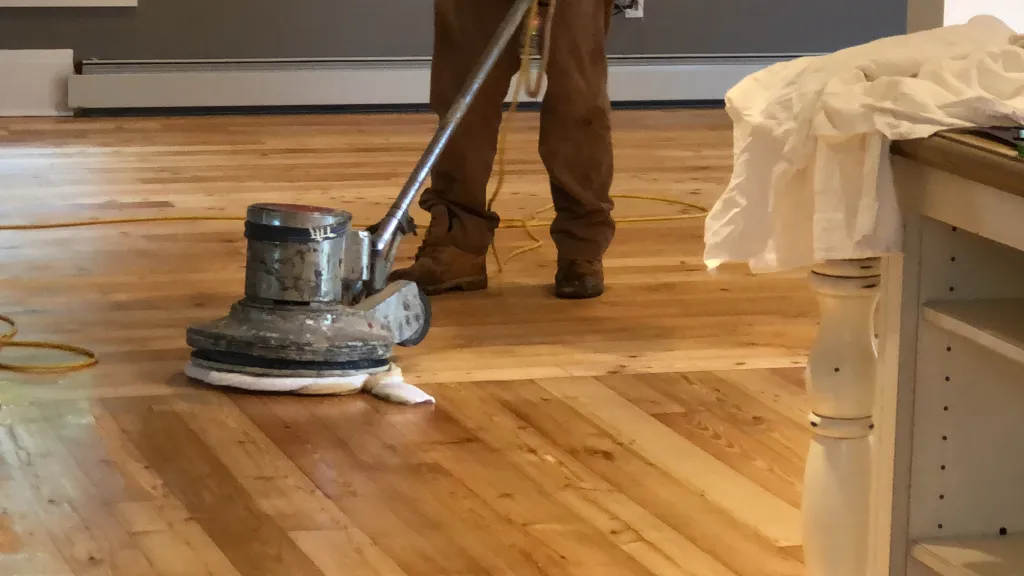
Progressive sanding grits remove the old finish and a controlled layer of wood surface. Each grit pass removes the scratch pattern from the pass before — final passes leave a clean, even surface for stain and finish.
- 3Stain Application (If Desired)
Refinishing is the opportunity to shift your floor's color — from lightening a dark espresso-stained floor to adding a gray or warm tone. We test color samples on your actual floor before committing to the full application.
- 4Finish Application
Two to three coats with light screening between coats. Water-based finish offers faster dry time and lower VOC odor. Oil-modified urethane adds amber warmth and is highly durable — we discuss both options and you choose.
- 5Cure Time & Re-occupancy
Normal foot traffic resumes 24 to 48 hours after the final coat. Furniture and area rugs return three to seven days later for full cure. A 3/4 inch solid hardwood floor can typically be refinished three to five times over its lifetime.
Why Is Dustless Refinishing the Right Choice for Occupied Long Grove Homes?
Traditional Sanding
Dust migrates through HVAC systems and settles on furniture throughout the home. Adjacent rooms need full protective covering. HVAC filters trap sanding dust.
Household re-occupancy is significantly disrupted for the project duration. High VOC oil-based finishes require extended airing-out periods.
Plamada Dustless Process
Vacuum-collection equipment attached to sanding machines captures 95 to 99 percent of dust at the source. Adjacent rooms need minimal protection. The home remains habitable during the project. Water-based finishes used in our dustless system produce significantly lower VOCs — faster re-occupancy and safer for households with children, pets, or respiratory sensitivities.
Dustless does not mean zero dust. Approximately 95 to 99 percent is captured at the source. A small residue may remain in the immediate work area — which is why we clean up thoroughly before leaving each day. This is the standard we use on every project — not an upgrade tier.
What Types of Hardwood Floor Damage Can We Repair in Long Grove?
Scratches & Surface Wear
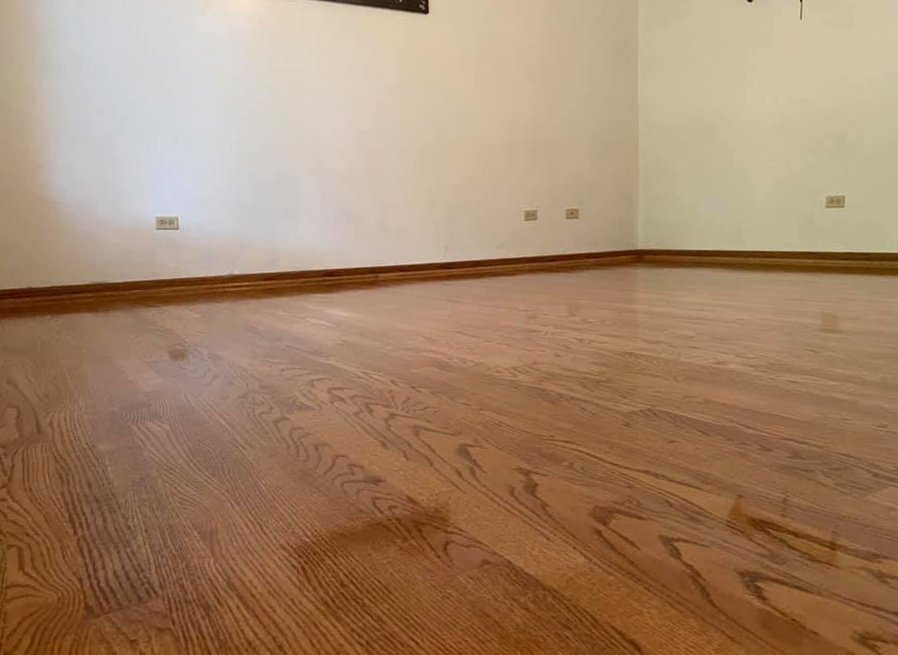
Light scratches that have not penetrated the finish respond to a spot recoat or buff-and-coat. Deeper scratches into the wood fiber require area sanding or board replacement if isolated.
Water Damage
Moisture levels must be assessed before any repair — refinishing over a still-damp floor will fail. Minor staining may sand out. Severe cupping requires board replacement after the moisture source is resolved.
Gaps Between Boards
Seasonal gaps that open in winter and close in summer are normal — no filling needed. Permanent gaps from improper installation or excessive drying can be filled with flexible filler matched to your floor stain.
Board Replacement
Individual boards can be replaced by a skilled installer and stained to match surrounding floors. Perfect color matching on an aged floor is skilled work — expect a close match, not always an invisible one.
How Do You Maintain Hardwood Floors in a Long Grove Home Long-Term?
- DailyMicrofiber Dust Mop
Sweep or dust-mop with a microfiber tool to remove grit before it acts as an abrasive underfoot. Grit is the primary cause of surface scratching in daily life — removing it daily extends your finish life significantly.
- WeeklypH-Neutral Hardwood Cleaner
Damp-mop with a hardwood-specific pH-neutral cleaner only. Do not use steam mops, oil soaps, or vinegar-based cleaners — all damage the finish over time. A damp mop is not a wet mop; excess moisture is the enemy.
- MonthlyInspect High-Traffic Zones
Check transition pieces, edges, and high-traffic areas for wear pattern development. Catching finish wear before it reaches bare wood is the key to avoiding a full sand rather than a screen-and-recoat.
- AnnuallyScreen-and-Recoat Assessment
Assess whether a light screen-and-recoat is warranted. A fresh coat of finish without sanding extends time between full refinishes by three to five years when done before the finish wears through to bare wood. This is a service we provide.
- Year-RoundHumidity Management
Run a humidifier in winter to keep indoor relative humidity above 35 percent. Use air conditioning or a dehumidifier in summer to keep it below 55 percent. Area rugs in the entry, kitchen transition, and hallway protect finish and reduce wear accumulation.
Unlike flooring providers that treat refinishing as a lower-priority service, Plamada Flooring provides the same level of preparation and care to restoration work as to new installation — because a refinish done wrong destroys a floor that a proper job would have saved for another 15 years.
- Refinish Cycles: Solid 3/4" hardwood supports 3–5 full refinishes over its lifetime — dependent on wood thickness above the tongue
- Dustless Capture Rate: 95–99% of sanding dust captured at source — the home remains habitable throughout the project
- Water-Based Finish: Lower VOCs, faster dry time, slight blue-white undertone — faster re-occupancy for households with children or pets
- Oil-Modified Urethane: Amber warmth, longer dry time, highly durable — preferred for period homes and warm-tone stain applications
- Screen-and-Recoat: Extends time between full sands by 3–5 years when done before finish wears through to bare wood
- Foot Traffic Resume: 24–48 hours after final coat for normal use; 3–7 days for furniture and area rugs to return
What Do Long Grove Homeowners Say About Our Hardwood Flooring Work?
The work speaks for itself — but Long Grove homeowners wanted specifics before they hired, so those specifics are here. Every review below names the project, the concern that was addressed, and the outcome. No generic praise, no anonymous sources.
Would highly recommend Plamada Flooring!! Adrian was extremely professional and responsive. They put new hardwood flooring in on our first floor and blended it in perfectly with our existing flooring. They also refinished our stairs and put in new posts and rails.
His team did a fantastic job sanding and staining our floors when we got a condo. They were professional, did the job in less time than estimated, were responsive to texts and emails, and the quality was outstanding.
10 out of 10 would recommend. Adrian and his team are pros. They showed up on time, did excellent quality work, and the customer service was above and beyond.
High quality materials and durable low VOC finish. If you have flooring needs, call Plamada.
Adrian was very reliable, professional and honest. We were under a tight schedule to move in and his crew did everything to make it work. I wouldn't hesitate to hire them again and their work is outstanding!
Ready to join our Long Grove homeowners? Tell us about your floors and we will get back to you within 48 hours.
Call (224) 421-0276What Should Long Grove Homeowners Know Before Investing in Hardwood Flooring?
Long Grove homeowners asking "how much does this cost?" are really asking two questions: what will I spend, and what will I get back? This section answers both — and adds a third dimension most flooring conversations skip entirely: what protection do you have if something goes wrong?
What Factors Affect the Cost of Hardwood Flooring in Long Grove, IL?
- Species and Grade
Premium species like walnut or wide plank white oak carry higher material costs than standard red oak. Clear-grade material with minimal character marks is priced above select or character-grade product. Species is often the largest single variable in material cost.
- Room Square Footage
Larger projects have lower per-square-foot labor cost due to installation efficiency. Irregularly shaped rooms with multiple angles add complexity and time — both factors are reflected in the final estimate.
- Subfloor Condition
A subfloor that needs leveling, patching, or squeak repair adds cost that cannot be determined until demo reveals the actual condition. This is the primary driver of mid-project cost surprises — and the reason an in-home estimate matters more than a phone quote.
- Installation Method
Glue-down over concrete or floating over existing floors may require additional materials — adhesive, vapor barriers, or underlayment — that increase the total project cost relative to a standard nail-down install over plywood.
- Old Floor Removal
Tearout and disposal of existing flooring — tile, carpet, vinyl, or old hardwood — adds to the total project cost. This is a variable we discuss at estimate so there are no surprises when demolition begins.
- Staircase Scope
Treads, risers, and stair nosing add material and labor cost beyond the flat floor estimate. Stairs require precise stain matching and careful sequencing — plan this upfront so material can be ordered and staged correctly.
- Finishing Method
Site-finished floors require an additional visit and cure time compared to prefinished products, and the labor for on-site sanding and finishing is reflected in the project total. The trade-off is complete color customization and a smooth look.
Phone quotes and square footage calculators cannot account for subfloor condition, room geometry, or species availability. Contact us to schedule a free in-home measurement — we give you a real number that reflects your actual home, not an industry average. Learn more about our hardwood flooring services or call directly to book your assessment.
Does Hardwood Flooring Actually Increase Your Long Grove Home's Resale Value?
The National Association of Realtors has consistently documented that buyers in the home-purchase process prefer hardwood flooring over carpet or vinyl — and that real estate professionals frequently cite flooring finish as a differentiator at the showing stage. In a market like Long Grove, where home values place it among Lake County's higher-end residential communities, the flooring finish is a visible first impression that buyers notice before they read a listing description.
Hardwood is among the flooring choices Realtors most frequently cite as contributing directly to asking-price confidence. Synthetic alternatives — LVP, laminate, tile in living spaces — do not deliver the same buyer signal in this market tier.
The pre-sale scenario is worth calling out specifically: refinishing existing hardwood before listing costs significantly less than full replacement and delivers comparable buyer appeal improvement. We provide this service. If you are preparing a Long Grove home for sale, an estimate on refinishing existing floors is worth requesting before committing to a replacement budget.
of real estate agents report that homes with hardwood floors are easier to sell — and that buyers are willing to pay more for them compared to equivalent homes with carpet or vinyl.
Source: National Association of Realtors — Remodeling Impact Report (Wood Floor Installation & Refinishing)Refinishing existing hardwood before listing typically costs a fraction of replacement while delivering comparable buyer appeal. Plamada Flooring provides pre-sale hardwood flooring refinishing in Long Grove that helps homeowners present their floors at their best before the first showing.
What Warranties Protect Your Hardwood Flooring Investment With Plamada Flooring?
Manufacturer Warranty
The hardwood products we carry come with manufacturer warranties covering manufacturing defects, finish wear, and structural integrity. These warranties are only valid when installation is performed according to the manufacturer's specifications — which is exactly why proper subfloor prep, correct installation method, and acclimation are not optional steps on our projects.
Warranty periods and coverage vary by product brand. We discuss the specific warranty for your product at estimate.
Workmanship Warranty
Plamada Flooring provides our own warranty on the installation work itself — separate from and in addition to the product warranty. This covers defects in the installation: fastening failures, improper expansion gaps, misaligned transitions, and issues that arise directly from the work performed.
If a problem arises, contact us directly. We assess whether the issue is product-related or workmanship-related and coordinate resolution. Neither warranty is buried in fine print.
The result? Homeowners who choose Plamada Flooring get two layers of protection from day one — manufacturer coverage on the product and our own coverage on the craft. We eliminate the gap that leaves homeowners stranded between a flooring company that blames the product and a manufacturer that blames the installer.
- Species Premium: White oak and walnut carry higher material costs than standard red oak — confirmed at estimate based on current stock availability
- Subfloor Surprises: Subfloor repair is the most common source of mid-project cost additions — only an in-home estimate after demo can confirm actual condition
- NAR Buyer Preference: National Association of Realtors data shows strong buyer preference for hardwood in Long Grove's market tier over synthetic alternatives
- Pre-Sale Refinish ROI: Refinishing before listing typically delivers greater buyer appeal improvement per dollar than full replacement at current Long Grove home values
- Manufacturer Warranty Validity: Only applies when installation follows manufacturer spec — all Plamada Flooring installations meet or exceed those specifications
- Workmanship Warranty: Covers installation defects separate from product — fastening, expansion gaps, transitions, and sequencing
Which Communities Around Long Grove, IL Does Plamada Flooring Serve?
We are based in and primarily serve Long Grove and the immediately surrounding communities of Lake County and northern Cook County. Familiarity with the construction styles, subfloor conditions, and architectural character of these specific neighborhoods translates into better-informed estimates and better-matched product recommendations — not generic advice for a generic home.
- Buffalo Grove, ILA mix of established ranch homes and newer construction — we frequently work with homeowners updating original 1970s–1980s strip oak floors or adding hardwood to newer builds.
- Lake Zurich, ILResidential growth over the past two decades has created a diverse mix of construction eras — from 1990s colonials to newer builds — each with different subfloor conditions and flooring needs.
- Barrington, ILHistoric character homes and larger equestrian estate properties — installations here often involve period-appropriate species choices and stair work that must match original architectural details.
- Kildeer, ILLarger-lot luxury homes with expansive open-concept floor plans — wide plank installations and whole-home species cohesion are common requests in Kildeer's newer executive builds.
- Vernon Hills, ILA growing residential community with a range of townhomes, condos, and single-family homes — we handle both residential and commercial flooring projects throughout the Vernon Hills area.
- Hawthorn Woods, ILNewer executive construction with larger room footprints and open layouts — Hawthorn Woods homeowners frequently request wide plank white oak and whole-home installations.
- Lincolnshire, ILCorporate campus proximity and established residential neighborhoods create a mix of move-in buyers and long-term homeowners — both groups regularly invest in hardwood upgrades and refinishing.
- Deer Park, ILA community of upscale homes in a low-density setting — Deer Park projects often involve premium species selections and site-finished floors to match high-end kitchen and renovation scopes.
Not sure if we cover your address? Call us at (224) 421-0276 — if you are in the Greater Chicagoland area, we likely serve your community.
For client types across Barrington, Kildeer, and Long Grove, the difference between a good flooring experience and a frustrating one often comes down to a contractor who knows the local housing stock. Plamada Flooring delivers hardwood flooring in Long Grove and surrounding Lake County communities with the product knowledge and local expertise that translates directly into better recommendations at your in-home estimate.
Get an Expert Eye on Your Long Grove Home's Floors — No Guesswork, No Pressure
Our estimate visit is not a sales call. You get a flooring professional who looks at your actual subfloor, measures your actual rooms, and gives you a specific product recommendation based on your household's real conditions — not an industry average from a phone conversation.
- No pressure, no sales tactics — we give you a real number and leave the decision to you
- Full in-home measurement included — subfloor condition assessed on-site
- We return calls and estimates within 48 hours — always
Request Your Free Estimate
No spam. No sales pressure. We respond within 48 hours.