
Hardwood Flooring in Buffalo Grove — Installed, Refinished, and Built to Last
Plamada Flooring delivers expert hardwood flooring in Buffalo Grove for residential and commercial spaces throughout the Greater Chicagoland area. We bring over seven years of installation and refinishing experience to every project — from initial product selection through the final coat of finish — with free estimates returned within 48 hours and a full satisfaction guarantee on every job we complete.
How Do Plamada Flooring's Installation and Product Options Work in Buffalo Grove?
Plamada Flooring handles every phase of your hardwood flooring project in Buffalo Grove, Illinois — from choosing the right product for your space through completed installation. Our team works with both residential homeowners and commercial clients, and we factor in the specific conditions of your home before making any recommendation. Here is what you need to know about how we work.
Solid and Engineered Hardwood: Choosing the Right Foundation
Plamada Flooring helps every Buffalo Grove homeowner choose between solid and engineered hardwood based on actual room conditions — not a sales script. Solid hardwood is milled from a single piece of wood to a standard ¾-inch thickness. It performs best in above-grade rooms with stable subfloors and consistent indoor humidity.
Buffalo Grove homes present specific conditions that make this decision meaningful. Finished basements, slab-on-grade additions, and rooms above garages all respond differently to seasonal humidity swings. We assess each space before recommending a product type.
Both product types come in a range of style formats: hand-scraped textures, wide-plank profiles, and your choice of prefinished or site-finished surfaces. We carry brands including Bruce, Shaw, Mirage, Anderson Tuftex, and Lauzon — each with distinct options across both solid and engineered construction.
Installation Methods We Use: Nail-Down, Glue-Down, and Floating
Our installation team selects the right method for your subfloor — not the easiest one to run. Three primary methods exist, and each one suits different conditions.
Nail-down uses cleats or staples to fasten planks directly into a wood subfloor. It is the traditional method for solid hardwood and produces the most mechanically secure result. Glue-down bonds planks to a concrete or wood subfloor with adhesive — the required method for many slab applications and commonly used with engineered hardwood.
Floating connects planks to each other rather than to the subfloor, creating an assembly that moves as a unit. This works well over radiant heat systems and on substrates with minor unevenness.
Before recommending any method, we assess your subfloor's flatness, moisture content, and substrate type. Improper method selection is one of the most common causes of floor failure in Illinois homes — a problem we prevent through a thorough pre-installation review. Most residential projects in Buffalo Grove complete in one to three days depending on room count and method selected.
Wood Species, Plank Widths, and Finish Options
We stock and install a full range of domestic and exotic wood species. Among domestic options, red oak delivers warm grain and a Janka hardness of 1290 — it is the most widely installed species in the country. White oak runs slightly harder at 1360 and takes stain evenly, making it the top choice for custom gray and natural tones. Maple reaches 1450 on the Janka scale with a tight, consistent grain.
Plank widths fall into three ranges: standard 2¼ to 3¼ inches, mid-plank 3½ to 5 inches, and wide plank above 5 inches. Wider planks require more stable subfloors and longer acclimation periods in variable climates like Buffalo Grove's.
Finish choices include prefinished floors with a factory-applied aluminum oxide coating — ready to walk on immediately — and unfinished floors sanded and stained on-site for custom color. Sheen levels run from matte through satin to semi-gloss. Matte and satin finishes show less everyday wear and are the most requested options in active Buffalo Grove households.
Custom Hardwood Floor Designs: Herringbone, Chevron, and Inlay Patterns
Our team installs pattern floors that go well beyond standard straight-lay. Herringbone places rectangular planks at 90-degree opposing angles to create a classic interlocking V-shape. Chevron cuts planks at a miter angle so the V-pattern forms a continuous, unbroken point — a more refined look than herringbone. Custom inlay and border work frames a room perimeter or centers a medallion within the field.
Pattern installations require 15–20% more material than straight-lay to account for cut waste at pattern junctions. They also take more installation time. The visual result is architecturally significant — particularly in open-concept homes in Buffalo Grove where a continuous pattern carries across connected living spaces.
Both solid and engineered hardwood work in pattern formats. For custom stain colors, we mix and test samples on-site. You approve the color in your own lighting — under your actual ceiling fixtures — before we commit to the full floor. That process matters most in open-concept spaces where a consistent tone across multiple rooms is the goal.
Solid and Engineered Hardwood: Choosing the Right Foundation
Plamada Flooring helps every Buffalo Grove homeowner choose between solid and engineered hardwood based on actual room conditions. Solid hardwood is milled from a single piece of wood to ¾-inch thickness. It performs best in above-grade rooms with stable subfloors. Engineered hardwood bonds a real wood veneer over a cross-ply plywood or HDF core, resisting humidity fluctuation better than solid wood.
Buffalo Grove homes present specific seasonal challenges that make this choice consequential. Finished basements, slab-on-grade additions, and rooms above garages all respond differently to humidity swings. We assess each space before recommending a product type. Style options include hand-scraped textures, wide-plank profiles, and prefinished or site-finished surfaces across brands including Bruce, Shaw, Mirage, Anderson Tuftex, and Lauzon.
Installation Methods We Use: Nail-Down, Glue-Down, and Floating
Our installation team selects the right method for your subfloor. Nail-down uses cleats or staples into a wood subfloor — the most mechanically secure result for solid hardwood. Glue-down bonds planks to concrete or wood using adhesive, required for many slab applications and commonly used with engineered hardwood. Floating connects planks to each other rather than the subfloor, working well over radiant heat and on substrates with minor unevenness.
Before recommending any method, we assess subfloor flatness, moisture content, and substrate type. Improper method selection is a leading cause of floor failure in Illinois homes. Most Buffalo Grove residential projects complete in one to three days depending on room count and method selected.
Wood Species, Plank Widths, and Finish Options
We install domestic species including red oak (Janka 1290), white oak (1360), maple (1450), hickory (1820), and walnut (1010). Exotic options include Brazilian cherry (2350), tigerwood, and acacia. Plank widths range from standard 2¼–3¼ inches to wide plank above 5 inches — wider planks need more stable subfloors and longer acclimation in Buffalo Grove's variable climate.
Prefinished floors with aluminum oxide coatings are ready immediately after installation. Unfinished floors get sanded and stained on-site for custom color. Matte and satin sheens show the least wear in active households and are our most requested finish options.
Custom Hardwood Floor Designs: Herringbone, Chevron, and Inlay Patterns
Our team installs herringbone (90-degree opposing planks), chevron (mitered planks forming a continuous V), and custom inlay or border work. Pattern installations require 15–20% more material than straight-lay and additional installation time. Both solid and engineered hardwood work in pattern formats.
For custom stain colors, we mix and test samples on-site so you approve the color in your own lighting before we commit to the full floor — a step that matters most in open-concept Buffalo Grove homes where a consistent tone across multiple rooms is the goal.
How Does Buffalo Grove's Climate Affect Your Hardwood Floors?
Buffalo Grove sits in a climate zone that punishes hardwood floors installed without local knowledge. Summer humidity in Lake County routinely pushes indoor relative humidity into ranges that expand wood. Winter forced-air heating pulls that humidity back down sharply. Our team factors these seasonal realities into every product recommendation and installation decision we make — because a floor that ignores Buffalo Grove's climate is a floor that will show problems within its first year.
How Illinois Winters and Humid Summers Affect Your Floors
Our Buffalo Grove installation process begins with a climate conversation because wood is hygroscopic — it absorbs and releases moisture based on the air around it. In summer, relative humidity in this area regularly reaches 70–80%. Boards expand.
In winter, forced-air heating systems push indoor humidity below 25%. Boards contract and gaps open between planks.
This seasonal cycle is normal. It becomes destructive when floors are installed without proper acclimation, when the wrong product is chosen, or when indoor humidity is never managed. The failure modes homeowners report in January include open gaps between planks.
In July, cupping appears — the edges of boards rise above their centers. In severe cases, boards buckle entirely.
These are not signs of a defective floor. They are signs of moisture imbalance. Buffalo Grove's climate makes this cycle more pronounced than in moderate coastal regions.
Recognizing that reality upfront is the first step toward a floor that performs for decades rather than seasons. We address subfloor moisture readings before any installation begins — and we document those readings for your records.
What Product Performs in Chicagoland's Climate?
Engineered hardwood is dimensionally more stable than solid hardwood in variable humidity environments. Its cross-ply or HDF core resists the swelling and contraction forces that act on a solid plank. This makes engineered hardwood the stronger recommendation for below-grade installations, rooms over concrete slabs, and spaces without consistent climate control in Buffalo Grove homes.
Solid hardwood remains appropriate for above-grade rooms with wood subfloors and reasonably consistent indoor humidity. Regardless of product type, hardwood flooring needs 3–5 days of acclimation in the installation space — longer for wide-plank material. Skipping acclimation is one of the most common causes of post-installation movement in Illinois homes.
How Should You Care for Your Floors Year-Round?
In winter, run a humidifier to keep indoor relative humidity between 35–55% — the best range for hardwood stability. Use felt pads on furniture legs. Avoid wet mopping.
Year-round, vacuum with a soft-bristle attachment (not a beater bar) to remove grit that acts as sandpaper underfoot. Address spills immediately. Avoid ammonia-based cleaners, wax on polyurethane-finished floors, vinegar solutions, and oil soaps. The single most preventable floor damage source in Buffalo Grove homes is tracked-in road salt and winter grit.
What Does Your Hardwood Warranty Actually Cover?
Two separate warranties apply to every hardwood floor installation. The manufacturer's product warranty covers defects in the flooring material itself — typically 25 years to lifetime on finish, shorter on structural integrity. The installation warranty covers workmanship — typically 1–2 years for labor depending on contractor.
These warranties are independent. A failure caused by installer error is not covered by the manufacturer. A material defect is not the installer's responsibility.
Common warranty-voiding actions include wet mopping, using non-approved cleaners, and failing to maintain indoor humidity within the recommended range. We provide written documentation of subfloor conditions and moisture readings at installation — that record protects you if a warranty claim is ever needed. Plamada Flooring sets the standard for hardwood flooring in Buffalo Grove through documented installation protocols that keep your warranty intact.
What Does Plamada Flooring Offer for Hardwood Refinishing and Repair in Buffalo Grove?
Our refinishing and repair work serves Buffalo Grove homeowners who are not buying new floors — they are looking at floors that are worn, damaged, or simply dull. Many floors assumed to need full replacement can be restored for a fraction of the cost. We handle everything from a quick buff and recoat to full sand and refinish to individual board replacement. Not every floor can be saved, but more can than most homeowners realize — and we will tell you honestly which category yours falls into.
Full Sand and Refinish vs Screen and Recoat: Which Do You Need?
Our team runs through this same triage on every refinishing call in Buffalo Grove. Full sand and refinish takes the floor down through the finish layer into raw wood, removing scratches, stains, and old finish entirely. New stain and finish coats go on fresh.
Each full sand removes approximately 1/16 to 1/8 inch of wood — solid hardwood can typically withstand 5–8 full refinishing cycles over its lifespan. Engineered hardwood, depending on veneer thickness, can handle 1–3 cycles.
Screen and recoat — sometimes called buff and recoat — scuffs the existing finish with an abrasive screen, then applies a new topcoat directly over it. No wood is removed. It is the right choice when the finish is dull or lightly scratched but the underlying wood is sound and finish has not worn through to bare wood.
Screen and recoat is appropriate when scratches stay in the finish layer. Full sand and refinish is required when scratches penetrate into the wood, when staining or pet damage reaches the wood surface, or when the floor has become uneven. The risk of over-sanding is real — unqualified operators who remove too much material in a single pass permanently reduce the floor's remaining refinishing life. Our crew tracks removal depth on every project.
Dustless Refinishing: Minimal Mess, Maximum Results
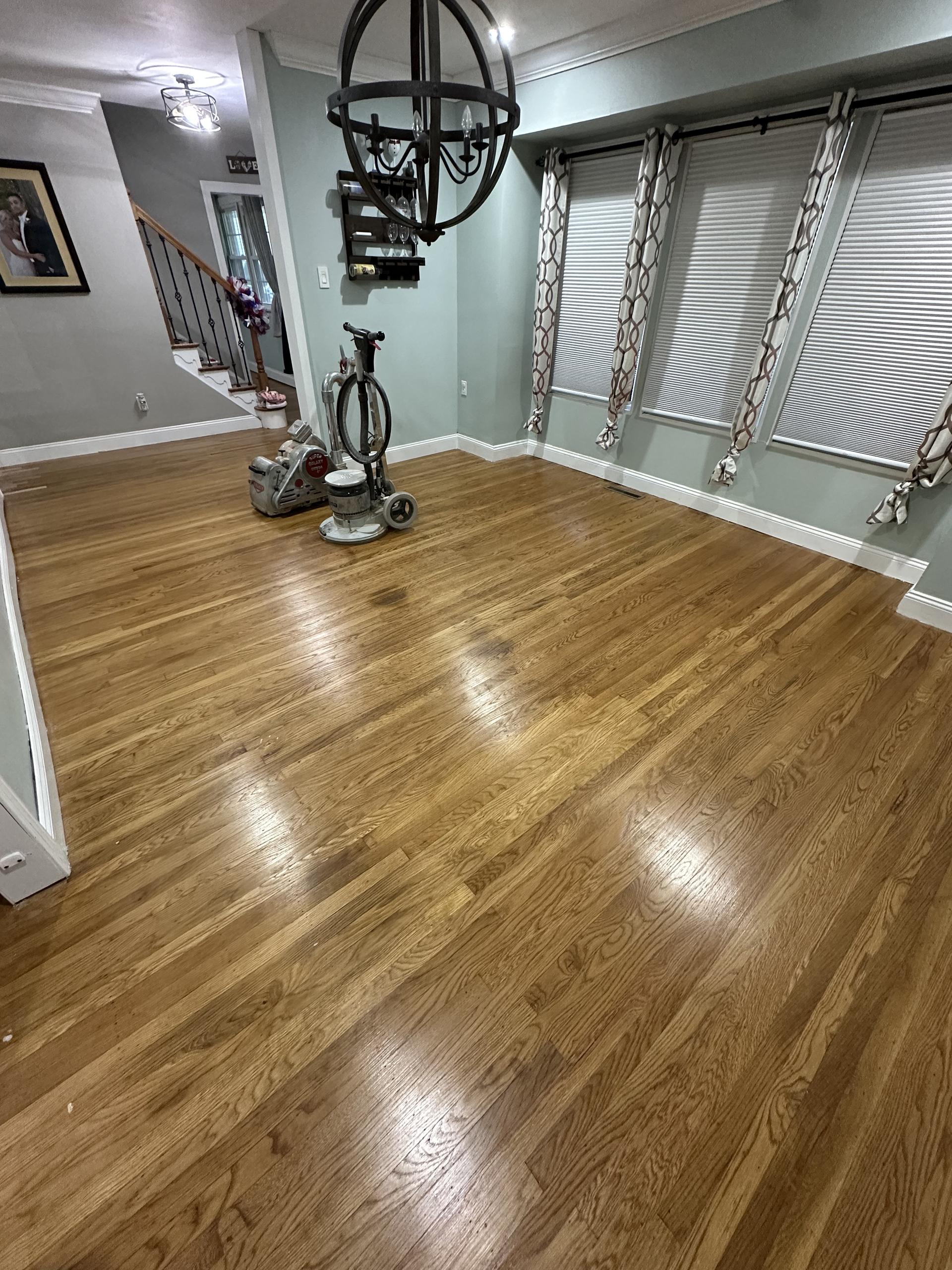
Our dustless refinishing system connects sanding equipment directly to a high-capacity HEPA vacuum containment unit that captures airborne dust at the point of generation. Traditional open-drum sanding releases fine wood dust that infiltrates HVAC systems and settles on surfaces throughout the home — clearing it takes days. Our system reduces airborne particulate by 95–99%, which means most families can remain in the home during the refinishing process.
This matters practically for households with children, allergy sufferers, or asthma — a documented concern among many Buffalo Grove homeowners. It also means your HVAC filters, furniture surfaces, and kitchen cabinets stay clean through the project.
After sanding, you choose your finish. Water-based polyurethane cures faster, carries lower VOC levels, dries clear without the amber tone of oil-based products, and is easier to live around. Oil-based polyurethane delivers a warmer tone and is generally more durable long-term, but requires longer dry time and stronger ventilation. Water-based finish has become our default recommendation for families and households with chemical sensitivities — and it carries significantly lower volatile organic compound levels than traditional oil-based formulations.
Hardwood Floor Repair: Scratches, Water Damage, Squeaks, and More
We handle the four primary repair categories that Buffalo Grove homeowners face on a regular basis.
Scratches and surface damage: Light surface scratches in the finish layer can often be resolved with screen and recoat. Deeper scratches that penetrate the wood require spot sanding and stain blending — skilled work, because matching the existing floor's stain color and sheen level is difficult, particularly on older floors where the color has shifted with age or UV exposure.
Water damage: Appliance leaks, roof intrusions, and basement moisture can cause board cupping, buckling, staining, or delamination in engineered floors. Affected boards may need individual replacement, followed by stain and finish blending to match surrounding boards. If urine has reached the subfloor, that area requires treatment or replacement before new boards go in.
Squeaks: Caused by boards rubbing against each other, against the subfloor, or against loose fasteners. The repair method depends on whether the subfloor is accessible from below — from a basement or crawl space, direct fastening addresses most squeaks efficiently. From above, we use specialized squeak-elimination screws that pull the board down to the subfloor without visible surface damage.
Pet urine damage: Urine that has penetrated through the finish into the wood leaves black staining that refinishing alone cannot address. Affected boards need replacement. If urine has reached the subfloor, that area needs treatment before new boards are installed. Hardwood species hardness does not affect urine resistance — prompt cleanup is the only preventive measure.
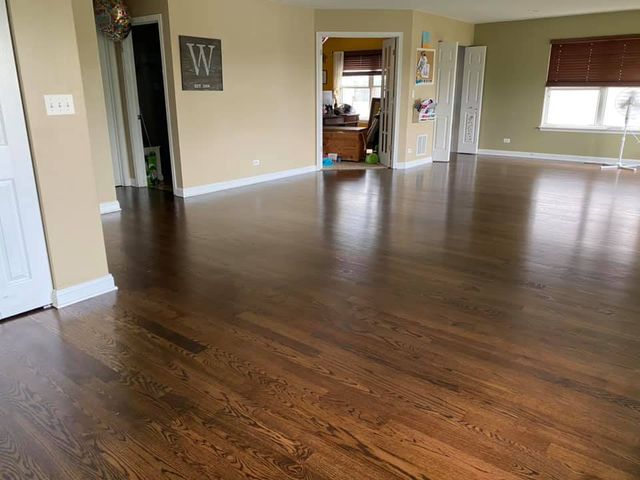
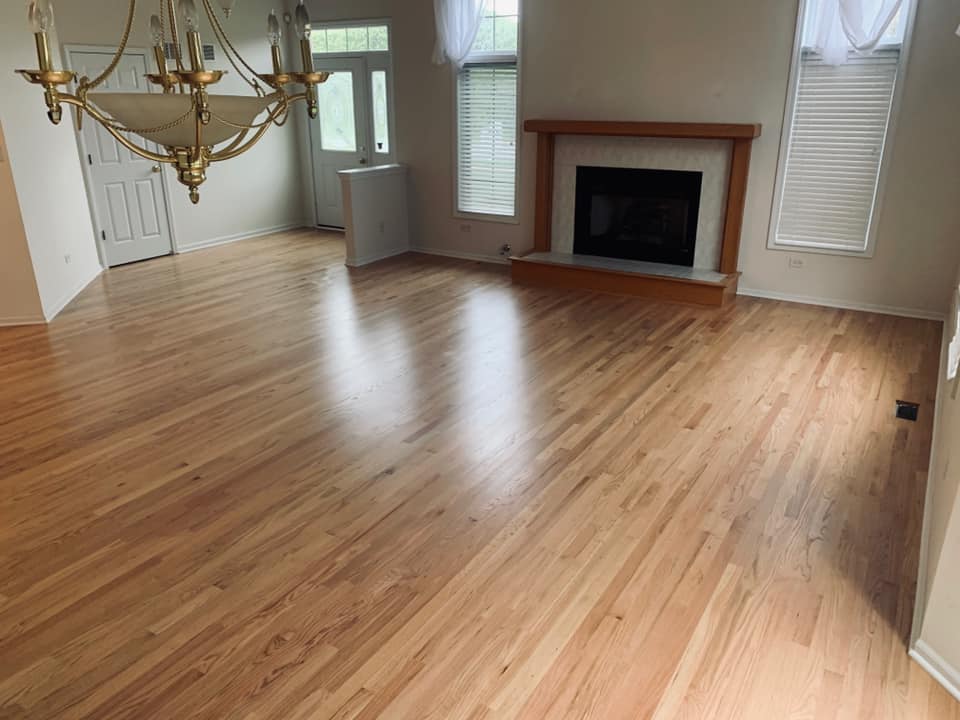
Before and After: Buffalo Grove Floor Transformations
Buffalo Grove homeowners need to see real local work — not stock photos — before trusting that their specific floor can be transformed. The projects below represent actual results from homes in the Buffalo Grove area. Ask us for a project gallery specific to your floor type or damage situation when you call for your estimate.

Is Hardwood Flooring the Right Choice for Your Buffalo Grove Home?
Hardwood flooring is not the right choice for every room or every situation — and it is our job to help you figure out whether it is. This section is a practical guide to making a confident decision. The answers here are honest, not promotional, because a homeowner who chooses the right product for their space is a homeowner who stays satisfied for decades.
How Does Hardwood Compare to Luxury Vinyl Plank, Laminate, Tile, and Carpet?
Each alternative has real strengths — and real limitations worth understanding before you decide.
Luxury vinyl plank (LVP) is 100% waterproof and installs quickly at a lower upfront cost. Its core limitation is permanence of wear: LVP cannot be refinished. When it shows damage, the only option is replacement. The best LVP products look similar to hardwood, but buyers and appraisers in the Buffalo Grove real estate market can distinguish them — and they do not add resale value the way real hardwood does.
Laminate is durable and affordable, but contains no real wood. The surface cannot be refinished. Moisture exposure causes swelling at seams — a known failure mode in Illinois's humid summers.
Tile handles moisture well and suits bathrooms and utility spaces. It is cold underfoot in Buffalo Grove winters and hard on joints. It is also visually inconsistent with wood-toned interiors most homeowners want across their main living spaces.
Carpet offers softness and lower upfront cost, but traps allergens, pet dander, and dust mites — a concern for allergy-sensitive households. It does not contribute to resale value in the same way hardwood does in this market.
In above-grade rooms with stable subfloors, hardwood delivers a combination of aesthetics, refinishability, and long-term value that no alternative product currently replicates. For expert hardwood flooring services matched to your specific Buffalo Grove space, the conversation starts with a free in-home estimate.
What Rooms Work Best with Hardwood Flooring in Buffalo Grove Homes?
Kitchen
Hardwood works in kitchens with a moisture barrier and prompt spill cleanup. Engineered hardwood is often the stronger recommendation over slab substrates in Buffalo Grove kitchens.
Basement
Solid hardwood is not recommended below grade in Buffalo Grove. Engineered hardwood with a proper vapor barrier works in below-grade rooms where moisture is managed and the slab is tested.
Bedroom
An excellent choice. Bedrooms offer stable environments — quieter underfoot than tile, warmer than tile, and far easier to maintain than carpet for allergy-sensitive households.
Living Room & Open-Concept
The most commonly requested hardwood flooring application in Buffalo Grove. Running planks in the same direction across connected spaces creates visual continuity through an open-concept floor plan.
Stairs
Hardwood stair treads and risers can match your floor. The key challenges are matching the existing species and stain, and ensuring treads carry the correct nosing profile for safety.
Hallways
Hardwood performs well in hallways. High foot traffic makes finish durability the primary criterion — harder species and low-sheen finishes are the right choice for Buffalo Grove hallways that see daily use.
What Are the Best Hardwood Floors for Families with Kids, Dogs, and Active Households?
Our team helps active Buffalo Grove families select species based on Janka hardness rather than appearance alone. White oak at Janka 1360, hard maple at 1450, and hickory at 1820 are our recommended domestic species for households with dogs. Brazilian cherry reaches 2350 and tigerwood is in a similar range — both offer extreme wear resistance for the most demanding applications.
Wire-brushed and hand-scraped textures naturally disguise minor scratches because their irregular surfaces make new marks less visible than on smooth finishes. Matte and satin finishes also show less everyday wear than semi-gloss. On dog nail scratches specifically — no hardwood floor is scratch-proof, but harder species and textured finishes significantly reduce the visual impact of daily pet activity. Unlike LVP, a scratched hardwood floor can be refinished back to its original appearance.
On pet urine: address this honestly — if urine reaches the wood, it stains. Species hardness does not affect urine resistance. Prompt cleanup is the only preventive measure.
If urine has penetrated the finish and reached the wood, those boards need replacement. Low-VOC water-based finishes are our standard recommendation for households with children or chemical sensitivities — they off-gas significantly less than oil-based alternatives during and after installation.
What Sustainable and Eco-Friendly Hardwood Options Does Plamada Flooring Offer in Buffalo Grove?
Hardwood flooring is inherently more sustainable than synthetic flooring materials that cannot be repaired or refinished and end up in landfill within 15–25 years. We offer three specific sustainable options for Buffalo Grove homeowners who want their choice to reflect their values.
FSC-certified hardwood carries the Forest Stewardship Council certification, meaning it comes from forests managed to standards protecting biodiversity, water quality, and worker rights. FSC certification is consumer-verifiable through the FSC's public database — not just a marketing claim.
Reclaimed hardwood comes from demolished structures — barns, factories, warehouses. No new trees are harvested. Reclaimed wood carries inherent character and patina that new-growth timber cannot replicate, and it is often available in wide-plank formats from old-growth timber no longer commercially available.
Low-VOC finish options: Water-based polyurethane finishes emit significantly lower volatile organic compounds than traditional oil-based formulations. We use low-VOC options as the default for households with children, asthma sufferers, or chemical sensitivities. Ask for documentation on any sustainability claim rather than accepting marketing language at face value — we are comfortable showing ours.
What Buffalo Grove Homeowners Say About Our Floors
Our work speaks through the homeowners who have experienced it. Every review below reflects a real Buffalo Grove project — you can verify them on Google at any time.
"Adrian and his crew showed up on time, assessed our floors honestly, and completed the full sand and refinish in two days. The custom stain they mixed on-site matched our trim perfectly. We couldn't be happier with the result."
"His team sanded and stained our condo floors when we moved in. Professional, responsive, and they finished ahead of schedule. The quality of work was genuinely above and beyond what I expected."
"10 out of 10. Adrian recommended hickory for our family room because we have two dogs. He was right — the wire-brushed finish hides scratches completely.
"Adrian was reliable, professional, and honest. We had a tight move-in schedule and his crew made it work. They also refinished our stairs and installed new posts and rails — the blend with our existing floor is perfect."
"I thought we needed full refinishing but Adrian looked at the floors and said a screen and recoat would do the job — and save us money. He was right. Floors look brand new. Appreciated the honesty more than anything."
"High quality materials, durable low-VOC finish, and the crew was professional from start to finish. They installed engineered hardwood throughout our main floor and it has held up beautifully through two full winters. Worth every penny."
How Do Hardwood Flooring Investment, Value, and Financing Work in Buffalo Grove?
Hardwood flooring is a home investment — not just an expense. Cost is a real consideration and we address it directly. We believe in transparent conversations about price from the first contact. Here is what drives project cost, what hardwood does for your home's value, and how flexible payment options can make your project possible right now.
What Affects the Cost of Hardwood Flooring in Buffalo Grove?
Square footage is the dominant cost variable. Larger projects cost more in total but often less per square foot because setup and mobilization overhead spreads across more area.
Species and grade matter too. Domestic species such as red oak and maple generally cost less than exotic alternatives. Character-grade materials — with more natural variation — often run less than select-grade, which shows clear and consistent grain.
Installation method affects labor time. Floating installation typically takes less time than nail-down or glue-down. Pattern installations such as herringbone add 15–20% more material for cut waste and require additional labor.
Subfloor condition is a hidden variable that surprises many homeowners. If your subfloor needs leveling, repair, or moisture mitigation, that work is priced as a separate line item. We perform a pre-installation subfloor assessment to surface these costs before any work begins — no mid-project surprises.
Finish type adds another variable. Site-applied water-based finishes require multiple coats and dry time. Prefinished products eliminate on-site finishing entirely. Furniture moving and debris disposal may or may not be included in a contractor quote — confirm these items explicitly when comparing bids.
Does Hardwood Flooring Increase Home Value in Buffalo Grove?
The National Association of Realtors and the National Wood Flooring Association consistently show hardwood flooring among the top home improvement features influencing buyer decisions. Studies show buyers willing to pay a measurable premium for homes with hardwood versus carpet or laminate.
In the Buffalo Grove real estate market — where median home values exceed national averages and buyers come in prepared — worn or dated floors are mentally discounted at negotiation. The cost of refinishing before listing is typically a fraction of that discount.
On the question of installing before a sale: if your home has hardwood under carpet, removing carpet and refinishing almost always returns more than it costs. If you are considering new hardwood purely for sale, the math depends on your home's price range and buyer profile — worth discussing with both a flooring professional and a real estate agent who knows the Buffalo Grove market.
What Flexible Financing Options Are Available for Your Flooring Project?
Hardwood flooring is a meaningful investment and many homeowners prefer to spread that cost over time. Financing options in the flooring industry include promotional 0% interest periods — typically 12–24 months for qualifying projects — monthly payment plans, and third-party financing through home improvement lending partners.
Availability varies by project size and applicant qualification. The benefit is straightforward: you complete the flooring project now, capturing the resale value and livability improvement immediately, rather than waiting months for savings to accumulate.
Serving Buffalo Grove and the Surrounding North Shore Communities
We are based in the Buffalo Grove area and serve the broader northern suburbs of Chicago — covering Lake County and Cook County communities throughout the northwest suburbs and North Shore.
Which Communities Does Plamada Flooring Serve Across Lake and Cook County?
Homeowners in surrounding towns often struggle to find a flooring specialist willing to make the trip — or they get quoted excessive travel premiums by distant contractors. Our team serves the genuine North Shore and northwest suburb community as a local resource. No special process, no travel surcharge, no different treatment for any address in our service area.
If you are in any of the communities listed here, contact us the same way a Buffalo Grove homeowner would — call or request an estimate online and we will schedule an in-home visit.
- Buffalo Grove, IL
- Long Grove, IL
- Lincolnshire, IL
- Vernon Hills, IL
- Deerfield, IL
- Wheeling, IL
- Unincorporated Lake County
Lake County
- Arlington Heights, IL
- Northwest Suburban Chicago
- Greater Chicagoland Area
Cook County
Ready to Transform Your Buffalo Grove Home?
Walk us through your space — we will walk you through everything else. Our team comes to your home, assesses your floors in person, and builds a recommendation based on what we actually see.
No obligation. We come to you. Estimates returned within 48 hours.