
Hardwood Flooring in Kildeer, IL — Installed Right, Built to Last
Plamada Flooring delivers professional hardwood flooring in Kildeer for homes and commercial spaces across Lake County. We handle installation, refinishing, and repair — with a free in-home estimate and a satisfaction guarantee on every project.
How Does Hardwood Flooring Installation in Kildeer, IL Work From Start to Finish?
Plamada Flooring handles every phase of hardwood flooring installation in Kildeer — from the first measurement to the final walkthrough. Installation is far more than laying boards. It involves honest assessment, proper preparation, smart method selection, and a structured process that protects your investment from day one. Here is exactly what to expect when you work with us.
What Steps Does Our Installation Process Follow?
Plamada Flooring runs every hardwood flooring project in Kildeer through a structured seven-phase process that eliminates guesswork and keeps homeowners fully informed. We start with an in-home assessment and precise measurement of your space. Next, we help you select the right product and place the order. Before a single board touches your floor, the wood acclimates to your home's specific humidity — this step is non-negotiable in Illinois, where the difference between warehouse and interior conditions can be dramatic.
Then we inspect and prepare the subfloor, complete the installation, and install all trim and transitions. We finish with a complete walkthrough so you can review every detail. Our crew coordinates furniture moving as part of the process — you don't manage that alone.
In-Home Assessment & Measurement
We visit your Kildeer home, measure each room accurately, and assess existing conditions before any product is ordered.
Product Selection & Ordering
We guide you through species, finish, and plank width choices suited to your home's conditions and lifestyle.
Wood Acclimation (3–7 Days)
The hardwood sits in your home to reach the correct moisture equilibrium. Illinois's indoor/outdoor humidity gap makes this step critical.
Subfloor Inspection & Preparation
We test for moisture, check levelness, and address any structural issues before installation begins.
Installation Day
Our crew installs your hardwood flooring using the method best suited to your subfloor type and product choice.
Trim & Transition Installation
All trim, thresholds, and transitions are fitted and secured for a clean, finished result throughout your home.
Final Walkthrough
We walk every room with you and confirm the work meets your expectations before we consider the job complete.

Why Does Subfloor Preparation Protect Your Flooring Investment?
Our subfloor preparation process covers three specific checks before any board is installed. First, we verify flatness and levelness — the industry standard allows no more than 3/16" variation over a 10-foot span. Second, we check structural integrity by pressing for soft spots, listening for squeaks, and confirming fasteners are tight. Third, we test moisture content.
Moisture testing is especially important in Kildeer and the broader Lake County area. Illinois homes experience significant seasonal moisture variation, and a subfloor that reads fine visually can still carry elevated moisture levels that will cause your hardwood to cup, gap, or squeak within a year of installation.
Most homeowners don't know their subfloor has a problem until a contractor finds it. We find these issues before the boards go down — not after. Addressing subfloor conditions upfront prevents the most common hardwood failures: gapping in winter, squeaking underfoot, and premature finish wear.
What Installation Methods Do We Use for Kildeer Homes?
We choose the right method based on your subfloor type, product, and room — not on preference.
Nail-Down (Staple-Down)
The traditional method for solid hardwood over wood subfloors. We install a vapor barrier first, then secure each board with a pneumatic nailer. This approach produces the firmest, most natural underfoot feel. It is the most common method in Kildeer homes built on crawl spaces or with full basements and plywood subfloors.
Glue-Down
Used over concrete subfloors and in many engineered hardwood applications. We apply a moisture-mitigating adhesive to the slab before placing each board. This method is common in Kildeer homes with slab-on-grade construction, including many ranch-style and split-level homes in the area. Proper adhesive selection and moisture testing are critical for long-term performance.
Floating
The planks lock together at the edges without being fastened to the subfloor below. This method works well with engineered hardwood and handles minor subfloor imperfections more forgivingly. It is often the right choice for basement-level rooms or spaces where gluing to a slab is not ideal. The method does not produce the same underfoot solidity as nail-down, but modern engineered products perform very well in this application.
How Long Will Your Hardwood Flooring Project in Kildeer Take?
We give you honest timeframes tied to your actual project — not blanket estimates that turn into surprises. Acclimation alone takes 3–7 days in a Kildeer home, depending on the season and the humidity gap between storage and your interior. A single room typically runs one to two installation days.
Larger homes, herringbone or chevron patterns, or significant subfloor repair will extend the timeline. We tell you upfront when that's the case.
This detail matters for scheduling. You need to know when to coordinate with movers, when other trades can enter, and when your family can return to normal routines. We walk through your project-specific timeline during the free in-home estimate visit so there are no surprises on either end.
What Hardwood Flooring Products, Species, and Styles Do We Carry?
We carry and install a curated range of hardwood products suited to Kildeer homes specifically. The number of choices can feel overwhelming — this section organizes your options into clear categories so the decision becomes straightforward.
Solid vs. Engineered Hardwood: Which Is Right for Your Kildeer Home?
Solid Hardwood
- A single piece of wood milled to 3/4" uniform thickness
- Can be refinished 4–8 times over its lifetime
- Best suited for above-grade installations over plywood subfloors
- More sensitive to Illinois humidity swings — expands in summer, contracts in winter
- Should not be installed below grade or directly over concrete without rigorous moisture mitigation
- Identical appearance to engineered once installed
Engineered Hardwood
- Real hardwood veneer bonded over a multi-ply plywood core
- Dimensionally more stable under seasonal humidity changes
- Better candidate for slab-on-grade homes, above-garage installations, and basement-adjacent rooms
- Premium products with 2mm+ wear layers can still be refinished multiple times
- Common in Lake County new construction and renovation projects
- Right choice depends on subfloor type, room location, and budget
The right product for your Kildeer home depends on your subfloor, installation location, and how long you plan to stay. We assess all three during your consultation so you never pay for the wrong product.
What Wood Species Does Plamada Flooring Install in Kildeer?
Our team installs all major domestic and select exotic species. Here is what you need to know about each before choosing.
Red Oak
Janka ~1,290Warm amber tones with visible grain. The most widely installed hardwood species in the US. Takes stain reliably and handles high-traffic areas well. Excellent value for Kildeer homes.
White Oak
Janka ~1,360Cooler gray-brown tones with tighter grain. More moisture-resistant than red oak. The most requested species in Lake County new construction and renovations right now. Accepts gray and natural stains beautifully.
Maple
Janka ~1,450Very hard and light in tone. Outstanding for high-traffic areas. Tight grain makes it harder to stain evenly, so many homeowners choose it with a natural or light finish. Great for modern and Scandinavian-style interiors.
Hickory
Janka ~1,820The hardest domestic species commonly installed. Dramatic grain variation and color contrast. Built for families with pets and children. If dent resistance is your top priority, hickory is the answer.
Walnut
Janka ~1,010Rich chocolate tones with a premium price point. Softer than oak, so better suited for lower-traffic rooms or homes without large dogs. One of the most visually striking choices available — worth the investment in the right space.
Brazilian Cherry & Exotics
Janka ~2,350+Exceptional hardness and deep reddish tones. Reclaimed and locally sourced hardwood options are also available upon request for homeowners who prioritize sustainability. We discuss exotic availability during your estimate appointment.
What Stain Colors, Plank Widths, and Surface Textures Are Available?
Three dimensions shape how your hardwood looks in your space — stain, width, and surface texture. Here is how each works.
Current design trends in the Lake County market favor natural and light tones — white oak naturals, pale grays, and blonde Scandinavian-inspired finishes are consistently popular in 2024–2025. Matte finishes are outselling high-gloss options significantly because they hide everyday dust and wear far better. Dark espresso floors remain relevant in specific design contexts but are no longer the dominant choice in new installations.
Wide plank flooring — 5 inches and above — creates an open, modern feel that suits the open-concept layouts common in Kildeer's newer subdivisions. Narrower planks at 2.25"–3.25" feel more traditional and pair well with older homes. Pattern installations including herringbone and chevron are available for homeowners seeking a designer look in a specific room or entryway.
Prefinished vs. Site-Finished Hardwood: Which Should You Choose?
Prefinished Hardwood
- Arrives from the factory with stain and finish already applied
- Installation is faster — home is often accessible same or next day
- Factory UV-cured aluminum oxide finishes are among the most durable available
- Slight bevel between planks is visible up close — normal for prefinished
- Finish color is fixed — no customization after ordering
- Good for projects with tight timelines or finish-odor sensitivity
Site-Finished (Unfinished)
- Sanded, stained, and coated on-site after installation
- Completely smooth look — no beveled edges between planks
- Full custom color control and the best option for matching existing floors
- Requires several additional days for coats and curing
- Water-based finishes reduce fumes significantly during this window
- Preferred method for home additions and large-scale renovations
Built for Illinois — Hardwood Floors That Handle Kildeer's Climate, Kids, and Pets
Kildeer homeowners face challenges that homeowners in more temperate climates simply don't — dramatic humidity swings between summer and winter, active households with dogs and kids, and growing awareness about indoor air quality. This section is our direct answer to those concerns.
Why Do Kildeer's Humidity Swings Matter for Your Hardwood Choice?
Wood is hygroscopic — it absorbs and releases moisture from the surrounding air, expanding as humidity rises and contracting as it drops. In the Chicago metro and Lake County area, indoor relative humidity can swing from 65–75% in summer to as low as 20–25% in heated winter interiors. That is a dramatic range. Solid hardwood experiences that range as constant dimensional movement.
This is why small gaps between boards commonly appear in Kildeer homes during January and February and close back up in spring. Within acceptable tolerances, this is normal behavior — not a defect. However, product selection matters. Engineered hardwood with a quality multi-ply plywood core is dimensionally more stable under these conditions than wide-plank solid hardwood, particularly for first-floor installs over a slab or in basement-adjacent spaces.
Maintaining indoor relative humidity between 35–55% RH year-round — using humidifiers in winter and air conditioning in summer — extends the life and appearance of any hardwood floor significantly. Acclimation before installation is essential for exactly this reason: it allows the wood to reach equilibrium with your home's specific conditions before it is locked in place.
What Are the Most Durable Hardwood Options for Families With Kids and Pets in Kildeer?
Not all hardwood holds up equally when children and animals are part of the daily picture. Janka hardness is the relevant metric — higher Janka scores mean more resistance to denting. Our top domestic picks for active Kildeer households are Hickory at approximately 1,820 Janka, Hard Maple at roughly 1,450, and White Oak at around 1,360.
Finish type matters as much as species. Aluminum oxide prefinished coatings are among the hardest surface finishes available. They resist scratching far better than traditional oil-based field finishes.
For pet households, it is worth separating two distinct concerns: pet nail scratching and pet urine. Scratching is mitigated by species and finish hardness. Urine that penetrates the finish can permanently stain or damage the wood, so prompt cleanup and a well-maintained finish coat are essential regardless of species.
Wire-brushed and hand-scraped surface textures are a practical choice for pet households because the existing texture camouflages light surface scratching naturally. No hardwood is fully scratch-proof — we set that expectation honestly during every consultation. Plamada Flooring provides species and finish guidance specific to your household as part of every free estimate.
Top Species for Active Households
What Low-VOC and Eco-Certified Hardwood Flooring Options Do We Offer?
VOCs — volatile organic compounds — are chemicals that off-gas from adhesives, stains, and finishes during and after installation. They affect indoor air quality and are a legitimate concern in homes with infants, toddlers, or residents with respiratory sensitivities. Water-based finishes emit significantly lower VOC levels than traditional oil-based finishes and cure faster, reducing the off-gassing window considerably.
We offer and recommend products carrying GREENGUARD Gold and FloorScore certification as third-party validation of low-emission standards. On wood sourcing, FSC (Forest Stewardship Council) certification verifies responsible forest management — an option we can source for homeowners who prioritize sustainability. Formaldehyde-free adhesive options are available for glue-down installations. We keep the guidance factual and certification-grounded so you can make an informed decision.
How Do You Maintain Hardwood Floors Through Illinois Seasons?
Summer
- Use AC to keep humidity below 55% RH
- Avoid damp mopping — dry or microfiber only
- Wipe spills immediately
- Use entryway mats to trap summer grit and sand
Fall
- Begin humidifier use as heating activates
- Inspect finish for wear before winter
- Check transitions and trim for gaps
- Assess whether a recoat is needed before cold season
Winter
- Maintain 35–45% RH with a whole-home humidifier
- Expect minor gaps in prolonged cold snaps — normal
- Use only dry microfiber mop — no steam or wet mop
- Place mats at all entry points to capture salt and moisture
Spring
- Gaps close naturally as humidity returns
- Good time to assess finish wear before summer
- Schedule a recoat or spot repair if needed
- Transition away from humidifier as outdoor conditions stabilize
Year-round fundamentals keep your hardwood performing well between refinishing cycles. Use felt pads on all furniture legs. Avoid dragging furniture across the floor.
A whole-home humidifier is the single most effective tool for protecting hardwood floors in Illinois. Room-level humidifiers help but cannot maintain consistent RH across larger homes. Plamada Flooring covers seasonal care guidance as part of our post-installation support — ask us during your walkthrough.
Does Your Kildeer Hardwood Floor Need Refinishing or Repair?
Many Kildeer homeowners have hardwood floors they've lived with for years. The most common question: can these floors be saved, or do they need to go? Plamada Flooring handles both refinishing and repair as standalone services — and honest assessment is part of every service call.
What Are the Signs Your Floors Need Refinishing, Not Replacing?
Here is how to self-diagnose before calling anyone. Your floors are strong candidates for refinishing if you notice worn finish in high-traffic paths — the wood looks gray or dull rather than satin or glossy. Light scratches that stop at the finish layer without penetrating the wood are also refinishable. Surface staining from spills that didn't fully absorb, minor sun fading, or boards that look tired but sit flat and feel solid underfoot are all signs refinishing will restore them fully.
Finish worn in traffic paths — wood looks gray or dull
Light scratches that stop at the finish layer — wood beneath undamaged
Surface staining from spills that didn't fully penetrate
Minor fading from sun exposure — boards still flat and structurally sound
Generally tired appearance — no cupping, buckling, or structural damage
When Replacement May Be Necessary
- Severe cupping or buckling that hasn't resolved after moisture source was eliminated
- Wood worn past 1/4" remaining thickness above the tongue — common after multiple prior refinishing cycles
- Widespread pet urine staining that has penetrated deeply through the wood
- Major structural damage across a significant portion of the floor
A solid hardwood floor can typically be refinished 4–8 times over its lifetime depending on original thickness. An in-home assessment is the only way to give you a definitive answer.
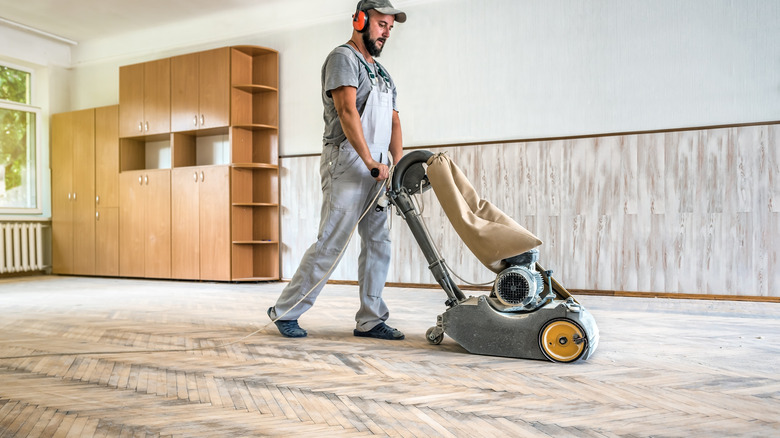
How Does Our Dustless Refinishing Process Work?
Our dustless sanding system handles the concern Kildeer homeowners raise most often about refinishing — dust throughout the home. A high-powered vacuum containment unit attaches directly to the sanding equipment, capturing the majority of dust at the source before it becomes airborne. "Dustless" is an industry term meaning dramatically less dust than open sanding, not literally zero — we set that expectation honestly.
Furniture Removal & Prep
We coordinate furniture removal from the space. Edge repairs and nail pop corrections happen before sanding begins.
Rough Sanding Pass
The dustless sanding machine removes the old finish and levels the surface. The vacuum containment system runs simultaneously.
Fine Sanding Pass
A second pass with finer grit prepares the wood for stain or finish absorption. Edges are hand-sanded for consistency.
Vacuuming, Tacking & Stain Application
The surface is vacuumed clean and tack-wiped before stain is applied. Stain patches are available before full commitment.
Finish Coat Application & Cure
Multiple finish coats are applied with proper drying time between each. Water-based finishes are available for low-odor, fast-reoccupancy projects.
What Staining and Finish Options Are Available for Refinishing?
Stain is optional — many Kildeer homeowners choose a natural or clear finish that shows the wood's own color. Those who want a specific tone have full control: lighter white-wash effects, warm honey tones, grays, and dark espresso are all achievable. We recommend testing stain patches on the actual existing floor before committing — a small sample reads very differently than a full floor under your home's specific lighting.
On finish type: water-based polyurethane dries fast, has low odor, stays clear over time, and is excellent for lighter stains and natural tones. Oil-based polyurethane imparts a slight amber tone, takes longer to dry, and carries stronger odor during application — though modern water-based products have closed the durability gap significantly. For sheen, matte and satin finishes currently dominate new refinishing projects in the Lake County market. They hide dust and minor wear far better than semi-gloss or high-gloss options, which is why homeowners who switch rarely go back.
What Types of Hardwood Floor Repairs Do We Handle in Kildeer, IL?
Board Replacement
Individual damaged boards can be removed and replaced to match existing floors. Achieving a perfect color match depends on the species, age, and current finish. Refinishing the repaired area after board replacement typically produces the best visual continuity — we assess this during the service call.
Gap Repair
Winter gaps that open and close seasonally are typically normal behavior and don't require intervention. Gaps wider than a credit card's edge that persist through summer may indicate a moisture issue or subfloor movement worth investigating. We help you determine which category your situation falls into before recommending any work.
Squeak Repair
Squeaks in Kildeer homes built in the 1990s–2000s are common. They are usually caused by subfloor movement or loose fasteners, not the hardwood itself. We can often address squeaks from below — through a basement or crawl space — or from above using specific fastening techniques. We diagnose the cause before recommending which approach makes sense for your home.
Water Damage Repair
Minor surface water staining can often be sanded out during refinishing. Cupping — boards bowed at their edges — is frequently caused by excess moisture below the floor and may resolve once the moisture source is eliminated. Do not sand a cupped floor until the moisture problem is fixed — premature sanding causes permanent damage.
Is Hardwood Flooring Worth It in Kildeer, IL? An Honest Look
Hardwood costs more upfront than most alternatives. The question of whether it is worth it is legitimate — not a trick question. Here is an honest look at where hardwood wins, where it doesn't, and what the investment means for a Kildeer home over the long term.
How Does Hardwood Flooring Compare to LVP, Laminate, and Tile?
Luxury Vinyl Plank (LVP)
LVP has improved significantly and is a legitimate product. It is 100% waterproof, more affordable upfront, and appropriate for below-grade spaces or high-moisture areas where hardwood is not the right choice. Where hardwood outperforms: LVP cannot be refinished when worn, has a plastic core that some buyers perceive negatively at resale, and carries a typical functional lifespan of 15–25 years before full replacement. Solid hardwood, refinished every 7–12 years, can last 50–100+ years in a well-maintained Kildeer home.
Laminate
The most affordable option but the lowest-longevity choice. Laminate cannot be refinished at all. The surface layer wears through in high-traffic areas and cannot be restored — only replaced.
Lifespan of 10–20 years is typical. The cost savings at purchase often disappear over a 30-year homeownership window when replacement cycles are factored in. Worth considering for rental properties or very tight budgets, but not the long-term value choice for a Kildeer primary residence.
Tile
Genuinely durable and water-resistant. Appropriate in specific rooms — bathrooms, mudrooms, and kitchens. Lifespan of 25–50 years with proper grout maintenance.
Drawbacks in living areas and bedrooms: cold and hard underfoot, grout requires periodic sealing and cleaning, and hard impact surfaces are harder on legs and dropped objects. Tile is not a competitor to hardwood in living rooms and bedrooms — it is a different product for different rooms.
For whole-home installations in Kildeer's resale market, hardwood has a consistent value perception advantage among buyers that LVP, laminate, and tile do not fully replicate. The right product depends on the specific room, subfloor, household, and budget — but hardwood remains the long-term value leader where conditions allow it.
What Does Hardwood Flooring Do for Your Kildeer Home's Resale Value?
The National Association of Realtors has reported that 54% of homebuyers say they would pay more for a home with hardwood floors, and that hardwood flooring consistently ranks among the top features buyers want. Return on investment estimates for hardwood installation vary by source and market — commonly cited figures run 70–80% ROI at resale. The floor doesn't return every dollar spent, but it contributes meaningfully to perceived value and buyer willingness to pay.
In Kildeer and Lake County's real estate market, where homes compete in the $500,000–$900,000+ range, dated carpet or worn vinyl in common areas is a tangible buyer objection. It affects list price conversations and negotiating use. Refinishing existing hardwood before listing is a high-ROI project specifically because the cost is far lower than replacement — but the visual result, fresh and uniform floors throughout, has outsized buyer impact.
Plamada Flooring works with homeowners planning a sale to time the project correctly. Our hardwood flooring service in Kildeer covers both installation and refinishing for pre-sale projects.
What Warranty Coverage Should You Expect From Your Hardwood Flooring Contractor?
Manufacturer Warranty
Covers defects in the product itself — finish delamination, milling defects, premature wear through the finish layer. Coverage periods vary widely by brand and product tier: 10 years on entry-level products, lifetime finish warranties on premium lines. Most manufacturer warranties require installation by a licensed professional and include humidity and moisture exclusions. If the floor was installed outside the specified RH range or over a moisture-compromised subfloor, the warranty may be voided entirely.
Installation Warranty
Covers the quality of the workmanship — gapping beyond normal tolerances, squeaking caused by poor fastening, or lippage between boards. This is the contractor's warranty, not the manufacturer's, and it varies by company. Homeowners who hire unlicensed or cash-only contractors often find themselves with no warranty recourse when problems appear six months later. Licensed status and a written workmanship warranty are the protections you are paying for when you choose a reputable local contractor.
Why Do Kildeer Homeowners Choose Plamada Flooring and Keep Coming Back?
Trust is earned by showing up, doing the work right, and standing behind it. Plamada Flooring has served Kildeer and Lake County homeowners for over seven years. The best evidence is found in what customers say after the job is done.
What Are Our Customers Saying About Their Experience?
These are real customers from Kildeer and surrounding Lake County communities who hired Plamada Flooring for installation, refinishing, or repair work. Unfiltered reviews are available on Google.
"Would highly recommend Plamada Flooring!! Adrian was extremely professional and responsive. They put new hardwood flooring in on our first floor and blended it in perfectly with our existing flooring. They also refinished our stairs and put in new posts and rails."
"10 out of 10 would recommend. Adrian and his team are pros. They showed up on time, did excellent quality work, and the customer service was above and beyond. High quality materials and durable low VOC finish."
"Adrian was very reliable, professional and honest. We were under a tight schedule to move in and his crew did everything to make it work. I wouldn't hesitate to hire them again and their work is outstanding!"
How Do You Vet Any Hardwood Flooring Contractor — Including Us?
Ask these specific questions before hiring any flooring contractor. We welcome every one of them during the free estimate appointment.
Are you licensed as a contractor in Illinois?
Do you carry general liability insurance and workers' compensation on every job?
Can you provide a written scope of work and contract before the project begins?
Will you perform a subfloor moisture test and inspection before installation?
What is your process if a subfloor issue is discovered mid-project?
What does your workmanship warranty cover and for how long?
Who does the actual work — your own crew or subcontractors?
Can you provide references from projects in Kildeer or Lake County in the last 12 months?
What Do You Get When You Work With Plamada Flooring?
Licensed & Fully Insured
General liability and workers' comp on every project. No shortcuts, no cash-only risk.
Local Crew, Not Subcontractors
The people who quote your job are the people who do the work. No strangers showing up on install day.
Written Contract, Fixed Scope
You know exactly what you're getting before work begins. No scope creep, no verbal agreements.
Subfloor Assessment Included
Every project starts with a moisture test and levelness check before a single board is ordered.
Post-Installation Support
A named contact for questions after the job is done — not a voicemail black hole.
Serving Kildeer and Surrounding Lake County Communities for Hardwood Flooring
Plamada Flooring is genuinely local to Lake County — not a Chicago-based operation sending crews into the suburbs. Being based in the area means familiarity with local housing stock, typical subfloor conditions, and the specific neighborhoods where we have done our best work.
Where Does Plamada Flooring Provide Hardwood Flooring Services?
Long Grove and North Barrington communities frequently feature larger estate-style homes where wide plank hardwood installations and custom herringbone patterns are common. Lake Zurich and Hawthorn Woods are active residential markets with strong new construction and renovation demand — both solid and engineered hardwood flooring are consistently requested. Buffalo Grove and Vernon Hills offer a mix of older 1980s–1990s homes that benefit most from refinishing services and newer builds seeking fresh installation.
No travel surcharge applies for service within the primary Lake County service zone. Homeowners outside this list should call to confirm coverage — we do not draw hard lines that exclude valid customers.
Does Plamada Flooring Offer In-Home Samples for Kildeer Homeowners?
In-Home Sample Consultation
Our specialist brings large-format flooring samples directly to your Kildeer home. You see exactly how each species, stain, and finish option looks under your actual lighting conditions — not under store or showroom fluorescents, which change color perception dramatically. This is the most accurate way to make a flooring decision and it is built into the free estimate visit. No extra trip, no extra cost.
Why In-Home Beats the Store
Big-box store samples are small, lit by commercial fluorescents, and surrounded by unrelated products. Decisions made in that environment rarely match what homeowners expect when the floor goes down. Bringing samples to your actual space — where your walls, furniture, and natural light are present — produces selections you will be satisfied with for decades.
Ready to Get Started? Here Is How It Works
Every project starts with a conversation — not a commitment. Let us take a look at your space, assess what your floors need, and give you a clear picture of what the project involves.
What Financing Options Are Available for Your Flooring Project?
A quality hardwood flooring project is a significant home investment. Financing options are available to help Kildeer homeowners move forward on their timeline without depleting savings. Types of financing include third-party home improvement financing, deferred interest options, and payment plan structures — ask us during the estimate appointment for specifics that fit your situation.
Financing a quality hardwood floor often makes more long-term financial sense than paying cash for a lower-quality alternative that requires full replacement in 10–15 years. The math over a 30-year ownership window tends to favor the durable product. We also welcome commercial flooring inquiries — small offices and retail spaces in Lake County are part of our residential and commercial service mix.
Schedule Your In-Home Visit
Call or contact us to set a time. We come to your Kildeer home at your convenience.
Get Approved for Financing
Ask about available financing options during the estimate appointment. No pressure — just information.
Start Your Flooring Project
Once scope and financing are confirmed, we schedule installation around your timeline.
Schedule a No-Obligation Visit — Find Out Exactly What Your Floors Can Become
Our specialist visits your Kildeer home, measures the space, tests the subfloor, discusses product options suited to your conditions, and provides a detailed written quote. No pressure, no commitment — just a clear plan for your floors.