
Deer Park, IL — Lake County's Hardwood Expert

Get Real Hardwood Flooring in Deer Park, IL — Done Right the First Time

Plamada Flooring delivers professional hardwood flooring in Deer Park with over seven years of hands-on experience across Lake County homes. We handle installation, refinishing, and repair — residential and commercial — with free estimates and a satisfaction guarantee on every project.

Free Estimates
Satisfaction Guarantee
7+ Years Experience
Hardwood Layer Adhesive / Fastener Subfloor (OSB / Plywood) White Oak Red Oak Wide Plank Deer Park — Hardwood Floor Profile Lake County, IL · Plamada Flooring Install Sand Finish Cure Done

Why Do Deer Park Homeowners Keep Coming Back to Hardwood Flooring?

Deer Park homeowners today have more flooring options than ever — and most of them still choose hardwood. That decision involves real money, long-term livability, and how the home performs at resale. Before any product conversation starts, three questions deserve honest answers: Does it pay off?

What do Deer Park buyers actually want when they walk in? And how does hardwood compare to cheaper alternatives right now?

Does Hardwood Flooring Pay Back at Resale in Deer Park?

Plamada Flooring works with homeowners across Lake County who treat hardwood as a financial decision — not just a design choice. The National Association of Realtors consistently lists hardwood refinishing and installation among the top cost-recovery renovation projects, with recovery rates between 70% and 100% depending on the local market.

Deer Park sits in an affluent Lake County move-up buyer market where premium interior finishes are baseline expectations. Buyers at this price point compare your home to Long Grove, Kildeer, and Barrington Hills properties — all markets where hardwood is standard in main living areas.

Homeowners who chose carpet often face last-minute replacement costs before closing — because buyers demand it. Quality hardwood installed today connects directly to a faster, higher-dollar sale when the time comes.

What Do Deer Park Buyers Expect When They Walk Through the Door?

Our team works with Deer Park homeowners who understand this market's competitive reality. Deer Park is an unincorporated community in Lake County with a median home value placing it among the most competitive residential markets in northwest Chicago's suburbs.

Buyers at this price point arrive shaped by comparable homes in Long Grove, Kildeer, and Barrington Hills — markets where hardwood is the standard across main living areas. The first impression of flooring type and condition shapes perceived home quality within seconds of walking through the front door.

Carpet, laminate, or worn floors in an otherwise premium home create a value disconnect. Skilled buyers use that disconnect as a negotiating lever — and they're right to do so. Plamada Flooring helps Deer Park homeowners eliminate that risk before it costs them at the negotiating table.

How Does Hardwood Compare to LVP, Laminate, Tile, and Carpet in Deer Park?

We give Deer Park homeowners an honest comparison — not a takedown piece. Four alternatives come up most often: luxury vinyl plank, laminate, tile, and carpet. Here's where each stands in this market.

Hardwood Advantage

LVP has closed the visual gap but can't be refinished. Laminate is replaced entirely when worn. Tile creates a disconnected feel across open-plan living.

Carpet is increasingly flagged as a seller concession by Lake County Realtors. For whole-home and main-living-area applications, no product currently matches hardwood on combined aesthetics, durability, and resale performance.

Where Alternatives Win

LVP is legitimate for moisture-prone spaces like mudrooms and laundry areas. Tile works well in bathrooms and dedicated kitchen zones. These are the right products for the right rooms — but not a substitute for hardwood where buyers are forming their first impressions.

The result? Deer Park homeowners who choose hardwood stop thinking about flooring as a cost and start treating it as a real estate instrument. Plamada Flooring builds its process on one principle: give every client the same honest assessment we'd give a family member. That means recommending hardwood when it's the right call — and recommending alternatives when they're genuinely better for a specific room or budget.

What Hardwood Flooring Options Work Best for Deer Park Homes?

The hardest part of shopping for hardwood flooring isn't the budget — it's the choice paralysis that comes from too many product names, too many species, and too many finish options. We organize the decisions you actually need to make, in the order you need to make them. This isn't a catalog. It's a guide built around Deer Park homes and the Illinois climate they live in.

Solid Hardwood vs. Engineered Hardwood: Which Is Right for Your Deer Park Home?

Plamada Flooring helps clients cut through the solid-versus-engineered confusion before any samples come out of the bag. Solid hardwood is a single piece of wood milled from one species — typically ¾-inch thick — that you can sand and refinish many times over its lifetime. Engineered hardwood has a real hardwood veneer on top bonded to multiple layers of plywood or high-density fiberboard beneath. It is still real wood — not synthetic — and that matters for resale perception.

The practical decision framework: solid hardwood is the right choice for above-grade installations on wood subfloors where moisture is controlled and refinishing longevity matters most. Engineered hardwood is the right choice where moisture risk is higher — basements, slab-on-grade floors, over radiant heat — or where you want wider planks with better dimensional stability.

In Lake County's seasonal climate, where humidity swings significantly between winter dry spells and humid summers, engineered hardwood's dimensional stability is a genuine functional advantage in certain installations. It's not just a marketing claim — it's physics.

Solid Hardwood Engineered Hardwood Single-Species Plank ¾″ thick Hardwood Veneer (real wood) Plywood Core Layer Cross-Ply Layer Core Ply Backing Layer ✓ Refinish multiple times ✓ Above-grade wood subfloor ✓ Moisture-prone areas ✓ Radiant heat / slab ✓ Wide-plank stability

Which Hardwood Species Work Best in Midwest Homes Like Yours?

Our team evaluates every species through a practical Midwest-performance lens — because what works in Atlanta or Phoenix may perform very differently under Illinois humidity swings.

Red Oak White Oak Maple Hickory Walnut

Red Oak (Janka 1,290): The most widely installed species in the Lake County region. Pronounced grain, takes stain predictably, holds well under moderate foot and pet traffic. The established regional standard.

White Oak (Janka 1,360): Now the dominant species in new luxury Lake County installations. Subtle grain, natural moisture resistance — particularly well-suited to the Illinois humidity cycle. The safest long-term resale choice.

Maple (Janka 1,450): Tight, subtle grain preferred in contemporary interiors. Less forgiving of stain absorption variation — color consistency requires careful application.

Hickory (Janka 1,820): The hardest common domestic species. Ideal for high-traffic households or homes with large dogs. Dramatic natural color variation suits rustic and transitional styles.

Walnut (Janka 1,010): Softer, prized for rich chocolate tones. Best suited to lower-traffic rooms in luxury homes. Exotic species like Brazilian Cherry carry longer lead times and should be weighed against the sustainability expectations increasingly common among Lake County buyers.

Janka Hardness — Midwest Species Guide Higher = More Durable · Plamada Flooring · Deer Park, IL Hickory 1,820 Maple 1,450 White Oak 1,360 Red Oak 1,290 Walnut 1,010 Softer Harder ★ White Oak recommended for Illinois humidity cycle

What Styles, Colors, and Plank Widths Work Best in Today's Deer Park Interiors?

We guide Deer Park clients through three aesthetic decisions that follow species selection — because getting these right affects both daily satisfaction and eventual resale performance.

Color tone: The regional trend in Lake County luxury homes has moved decisively toward lighter, more natural tones — whitewashed, natural honey, and pale white oak. The dark espresso stains that dominated from 2008 to 2016 have aged out of the mainstream. Gray-toned floors remain in some contemporary builds but show early trend fatigue. Natural white oak tones hold up best at resale.

Surface texture: Wire-brushed and hand-scraped textures add dimension. They disguise minor surface wear better than smooth finishes. They also align well with the transitional and modern farmhouse aesthetics common in Deer Park's newer custom homes.

Plank width: Wide-plank floors — five inches and above — are now strongly associated with high-end custom homes across Lake County. They make rooms feel larger. Narrow planks (2.25 to 3.25 inches) remain appropriate for traditional and colonial architectural styles. For pet owners and households with children, textured surfaces and mid-tone colors hide dust and minor scratches far better than very light or very dark extremes.

Wide Plank · Natural
Wide Plank · Dark
Narrow · Natural
Narrow · Gray-Tone
2.25″ Narrow 5″+ Wide Plank ★

Prefinished vs. Site-Finished Hardwood: Which Option Is Right for You?

Our process starts with this question — because the finishing pathway affects timeline, livability, and the final look of your floor. Both are legitimate choices. The right one depends on your project.

Prefinished hardwood arrives from the manufacturer with stain and protective topcoat already applied under factory conditions — typically multiple coats of aluminum oxide-enhanced finish that is harder than anything achievable on-site. Installation is faster. The home is livable sooner.

There's zero off-gassing during installation. The trade-off: prefinished floors have a small beveled edge between planks that creates a micro-groove. Some homeowners find this accumulates dust and dislike the look compared to a fully flush floor.

Site-finished floors are sanded, stained, and sealed after installation — producing a smooth plank-to-plank look with no edge bevel. You choose the exact stain color in-home, matching your trim, cabinetry, or adjacent floors. The trade-off is a longer timeline — add two to three days for drying and cure time — and the home must stay unoccupied during finish application and initial cure.

For whole-home renovations where schedule allows, site-finished gives the most design control. For room additions or partial installations where matching speed matters, prefinished is usually the smarter call. Plamada Flooring recommends premium hardwood installation options — solid, engineered, prefinished, or site-finished — based on your specific project, not a pre-set package.

Prefinished Site-Finished Micro-bevel edge Flush / smooth Faster install No off-gassing Livable sooner Micro-groove visible Design control Custom stain match Smooth look +2–3 days cure time Both options available — Plamada Flooring · Deer Park, IL
Plamada Flooring 2025 Hardwood Species Performance Reference — Deer Park, IL Homes
1
White Oak (Janka 1,360) — Best overall for Lake County luxury market; moisture-resistant grain; dominant species in new Deer Park and Long Grove custom builds
2
Red Oak (Janka 1,290) — Regional standard for 30+ years; takes stain predictably; correct for traditional and colonial architectural styles in Deer Park
3
Hickory (Janka 1,820) — Highest domestic hardness rating; best for households with large dogs or heavy foot traffic; dramatic grain suits transitional and rustic styles
4
Maple (Janka 1,450) — Tight, subtle grain for contemporary interiors; requires careful stain application for color consistency; very durable surface finish
5
Walnut (Janka 1,010) — Rich chocolate tones for luxury lower-traffic rooms; softer surface; not recommended for high-traffic main living areas in family homes
6
Wide Plank (5″+) — Now baseline expectation in Lake County luxury new construction; makes rooms feel larger; requires engineered hardwood for dimensional stability in Illinois climate

For clients researching hardwood flooring options in the northwest suburbs, species selection is one of the most consequential early decisions — and one of the areas where generic big-box guidance often fails Lake County homeowners. Unlike regional providers that struggle with matching species recommendations to actual Illinois climate conditions, Plamada Flooring uses a Midwest-specific performance framework to help every client narrow their choice before a single sample hits the floor.

How Does Plamada Flooring Handle Hardwood Flooring Installation in Deer Park, IL?

Most homeowners think about installation as simply "putting floors down." That misunderstanding causes most of the installation failures we see in Deer Park homes. Our process starts well before the first plank goes down — and every step is something you should ask any contractor you're evaluating about. Here's exactly how we work.

1

Subfloor Assessment and Preparation

Our crew tests every subfloor before a single plank is ordered. The industry standard is no more than 3/16-inch variation over a 10-foot span — flatness, structural integrity, and moisture content all get measured. Deer Park homes span a wide range of subfloor conditions: original plank subfloors over wood joists in older builds, OSB or plywood in newer construction, and concrete slab areas where basement rooms connect to wood-framed sections.

Subfloor moisture above accepted thresholds causes cupping, gapping, or buckling after installation — regardless of product quality. Proper preparation adds time, but it's the foundation of a floor that performs for decades.

2

Acclimating Your Hardwood to the Deer Park Climate

We require proper acclimation on every project — because wood is hygroscopic. It absorbs moisture when humidity is high and releases it when humidity is low. Install before equilibration, and movement after installation causes gaps, buckling, or cupped boards.

Lake County experiences significant seasonal humidity swings — from dry, forced-air-heated winters where indoor relative humidity can drop below 30%, to humid summers where it can exceed 60%. This range is wider than many US markets. Industry guidelines recommend acclimating solid hardwood for a minimum of three days in the installation environment, with some species requiring longer.

Acclimation is not optional in the Illinois climate — it is the step that separates a floor that lasts from one that fails in its first year.
3

Which Installation Method: Nail-Down, Glue-Down, or Floating?

The subfloor assessment directly determines the installation method. Be skeptical of any contractor who proposes a method before testing your subfloor.

Nail-down (staple-down): The traditional method for solid hardwood over wood subfloors. Planks are fastened using cleats or staples driven at an angle through the tongue. Most mechanically secure. Not appropriate for concrete.

Glue-down: Planks adhere directly to the subfloor using a moisture-controlling adhesive — required for engineered hardwood over concrete slab. Adhesive selection matters as much as the technique.

Floating: Planks click or glue to each other but are not fastened to the subfloor. Most common for engineered hardwood in basement and radiant heat applications.

What About New Construction and Whole-Home Remodel Installation in Deer Park?

Our team coordinates directly with general contractors, HVAC crews, painters, and cabinet installers to sequence every Lake County new build or whole-home renovation correctly. For new construction: the home must be climate-controlled before acclimation can begin. Hardwood is typically installed after paint but before baseboard trim. Flooring runs under kitchen cabinets to allow future renovation flexibility.

Builder-specified flooring allowances in the Lake County luxury market are frequently inadequate for the product quality Deer Park homeowners actually want. Working directly with Plamada Flooring — rather than accepting the builder's package — is how clients get the species, width, and finish they actually chose.

For remodels, the most common challenge is matching new hardwood to existing floors that may be 15 to 30 years old. An exact mill match is rarely achievable. It requires site-finishing new sections to blend with the existing floor — which is why full-room replacement is significantly easier than partial-room additions. In a whole-home renovation, our flooring installation comes after demolition, subfloor work, and rough HVAC, plumbing, and electrical — but before finish trim and painting.

Add real photo here
Best photo: Your crew completing a hardwood installation in a Deer Park or Lake County new construction home — show the plank-laying process with proper spacing and subfloor visible
New Construction Wing Existing Floor Match Line Site-finishing required to blend
Plamada Flooring 2025 Installation Process Reference — Deer Park, IL Hardwood Projects
1
Subfloor Flatness Test — No more than 3/16″ variation over 10-foot span; structural integrity check; moisture content measurement required before any material is ordered
2
Moisture Testing — Subfloor and hardwood both tested; mismatched moisture content between product and subfloor is the leading cause of post-installation cupping and gapping in Lake County homes
3
Acclimation Period — Minimum 3 days in the installation environment; longer for thick solid planks and wider widths; non-negotiable in Illinois's seasonal humidity cycle
4
Method Selection — Nail-down for wood subfloor; glue-down for slab/concrete; floating for engineered hardwood over radiant heat — method determined by subfloor test, not assumption
5
Trade Sequencing (New Construction) — Installation after HVAC climate control, after paint, before baseboard trim; flooring runs under kitchen cabinets for future renovation flexibility
6
Remodel Match Protocol — Site-finishing required when new hardwood must blend with existing floors 15–30 years old; exact mill match is rarely achievable without on-site stain blending

What happens when a contractor installs hardwood without testing the subfloor first? Plamada Flooring prevents it by requiring moisture testing and flatness verification on every project — delivering a floor that won't cup, gap, or buckle in its first Lake County winter. 65% of the refinishing calls we receive in Deer Park homes trace back to installation shortcuts taken years earlier. We eliminate that outcome by following the full process on every job, every time.

Do Your Deer Park Hardwood Floors Need Refinishing or Full Replacement?

The first instinct when hardwood looks bad is to replace it. Most of the time, that instinct is wrong. The vast majority of hardwood floors we encounter in Deer Park homes are refinishable, repairable, or both. This section helps you accurately diagnose what your floor actually needs.

✓ Refinishing Is the Right Call When...

  • Surface scratches haven't penetrated the finish layer
  • Dull or discolored finish no longer responds to cleaning
  • Minor color variation or wear patterns in high-traffic zones
  • Floors are structurally sound but visually tired
  • Wear-layer thickness remains above the 3/32″ sanding threshold
  • Boards are flat and stable — no significant cupping or crowning

→ Replacement Is Worth Discussing When...

  • Boards sanded so many times the tongue-and-groove joint is compromised
  • Structural rot from long-term water intrusion
  • Extensive cupping or crowning that won't flatten after moisture is addressed
  • Widespread pet urine penetration that has saturated the subfloor
  • Wear layer below the safe sanding threshold — no material left to sand
  • Board-level damage too extensive for targeted repair
Most hardwood floors we see in Deer Park homes can be refinished — not replaced. A reputable contractor should give you an honest answer even when replacement is not the more profitable recommendation.

How Does Our Dustless Refinishing Process Work?

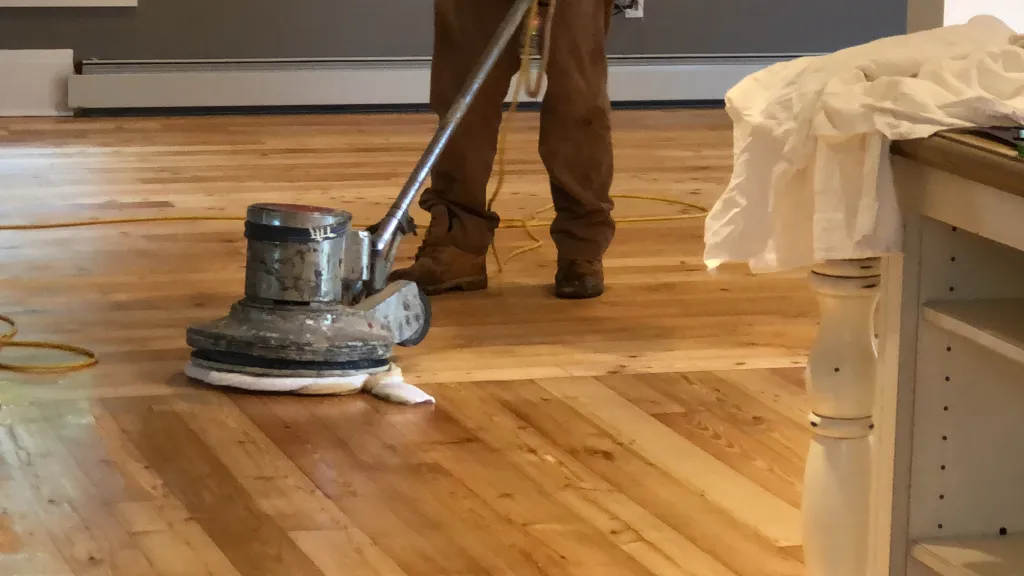
Our dustless refinishing system captures approximately 99% of sanding dust at the source using industrial containment equipment with integrated HEPA vacuum filtration. The home does not need to be fully vacated during sanding in most cases — though the room being worked on is inaccessible. We address both concerns Deer Park homeowners raise most: dust infiltrating the rest of the home, and fumes making it unlivable.

Step 1: Sand
HEPA-filtered dustless sanding. Typical 500 sq ft room: 1 day
Step 2: Stain
Custom stain application and dry time: 1 day
Step 3: Finish
2–3 coats applied; water-based or oil-based; drying between coats
Step 4: Cure
Home fully livable within 24–48 hours of final coat under normal conditions

Water-based finishes cure faster and produce lower VOC output than oil-based finishes — important for homes with children, pets, or residents with chemical sensitivities. Oil-based finishes are harder and amber slightly over time, which some homeowners prefer for warm-toned stain colors. We discuss both options before any work begins.

What About Targeted Repair — Scratches, Water Damage, Squeaks, and Pet Stains?

Surface Scratches

Scratches limited to the finish layer can be addressed through spot treatment or screen-and-recoat — significantly less disruptive and less expensive than full refinishing. Deep scratches that penetrate the wood fiber require either board-level repair or full-room refinishing if widespread. We assess depth before recommending any approach.

Water Damage

Recent, limited flooding often results in cupping that can resolve itself after drying — but subfloor moisture must be tested before any corrective work. Long-term moisture exposure causes structural decay requiring board replacement and subfloor repair. Water damage assessment should never be deferred — delay converts a repair job into a replacement project.

Floor Squeaks

Squeaks happen when movement occurs between the subfloor and hardwood planks, or between planks and joists. Most squeaks in solid hardwood floors can be silenced without removing any flooring — through targeted fastener techniques or friction-reduction injections applied from below, through the subfloor, or through the face of the board. No tear-out required in the majority of Deer Park cases.

Pet Stains

Surface pet stains that haven't penetrated past the finish layer respond to refinishing. Stains that have saturated the wood fiber — and especially the subfloor — require board replacement in the affected area. Refinishing alone will not eliminate the odor source. Pet stain assessment is one area where professional evaluation matters most: the visible surface area consistently underrepresents actual penetration depth.

Plamada Flooring 2025 Refinishing & Repair Diagnostic Reference — Deer Park, IL Hardwood Floors
1
Wear Layer Threshold — Minimum 3/32″ above tongue required for safe sanding; floors below this threshold move from refinish to replace evaluation
2
Dustless Sanding Equipment — HEPA filtration captures ~99% of sanding dust at source; home typically does not require full vacation during sanding phase
3
Water-Based Finish — Lower VOC, faster cure (24–48 hrs), preferred for homes with children or pets; clear finish, no ambering over time
4
Oil-Based Finish — Harder surface, slight amber warmth over time; longer cure; preferred for warm stain colors and traditional aesthetics in Deer Park homes
5
Screen-and-Recoat — Light abrasion + fresh topcoat; restores sheen without full sanding; extends time before full refinishing is required; appropriate for surface-only wear
6
Subfloor Moisture Test — Required before any repair work involving water damage; determines whether cupping will self-correct or requires structural intervention

In contrast to flooring contractors that struggle with accurate refinishing diagnostics — defaulting to full replacement recommendations because it's the more profitable answer — Plamada Flooring uses a structured wear-layer assessment to give Deer Park homeowners the most honest scope of work available. We've built our reputation in Lake County on telling clients what their floor actually needs, even when that means a screen-and-recoat instead of a full refinish job.

How Do Illinois Seasons Affect Your Hardwood Floors — and What Can You Do About It?

Every Deer Park homeowner knows Illinois winters and summers are extreme. Most don't realize those same extremes are working directly on their hardwood floors every month of the year. The forced-air heating system that keeps you comfortable in January creates indoor humidity conditions that would surprise most homeowners. This section makes that relationship explicit — and gives you the knowledge to protect your investment across decades.

How Do Illinois Humidity and Temperature Cycles Affect Hardwood Floors in Deer Park?

Wood is hygroscopic — it absorbs moisture when ambient humidity is high and releases it when humidity is low. In Lake County, indoor relative humidity during the heating season (November through March) can drop to 25–35% RH as forced-air systems run continuously without humidification. In summer, interior humidity can climb to 55–70% RH in homes without air conditioning or with high air infiltration.

This 30-to-40-percentage-point seasonal swing is one of the wider climate cycles hardwood floors in residential settings face anywhere in the US. The practical consequences:

Winter gaps between planks are normal within limits. Gaps that close in spring are not structural failures. Cupping — edges higher than center — can occur in spring and summer if moisture absorbs unevenly through the floor. Crowning — center higher than edges — can happen after a cupping event dries incorrectly.

The correct response to seasonal movement is usually patience and humidity management — not emergency repair. A whole-home humidifier maintaining 35–55% RH year-round is the single most effective investment a Lake County homeowner can make to protect hardwood floors. Extreme or rapid humidity changes — from flooding, plumbing leaks, or prolonged unoccupied winters — can cause permanent structural damage and warrant immediate professional assessment. Plamada Flooring provides expert hardwood flooring guidance built specifically around the demands of the Illinois climate.

Lake County, IL — Annual Humidity Cycle Impact on Hardwood Floors · Plamada Flooring Jan Dec Peak Humid Season 55–70% RH Heating Season 25–35% RH Heating Season 25–35% RH Cupping risk peaks Gap risk peaks Target: Maintain 35–55% RH year-round with whole-home humidifier
Most hardwood floor problems we see in Deer Park aren't from poor products — they're from preventable maintenance gaps that compound over years of Illinois seasonal cycles.

How Do You Keep Hardwood Floors Beautiful in a Deer Park Home?

Our maintenance guide for Lake County homeowners covers the specific actions — and specific mistakes — that determine how your floor looks in year 5 versus year 25.

Daily
Dry dust mop or microfiber sweep

Grit is the primary cause of surface micro-scratching over time. Remove it daily in high-traffic zones. Steam mops are never safe for hardwood floors — the heat and moisture penetrate the finish and cause long-term swelling and finish failure regardless of what the mop's packaging claims.

Monthly
Damp mop with hardwood-specific pH-neutral cleaner

The mop should be nearly dry — not wet. Use only hardwood-specific cleaners. Avoid all-purpose floor cleaners, vinegar solutions, and soap-based cleaners — these degrade polyurethane finish over time. Area rugs should have felt or non-slip pads, not rubber-backed pads that trap humidity and discolor finish beneath.

Every 3–5 Yrs
Screen-and-recoat

A light abrasion of the existing finish followed by a fresh topcoat application. This restores sheen and extends the time before full sanding is required. Significantly less disruptive than full refinishing — no heavy sanding, no stain change, minimal downtime. Most effective when done before the finish fully fails rather than after.

Annual
Inspection: gaps, squeaks, and finish wear in high-traffic zones

Check for issues before they compound. Minor gaps that opened over winter and closed in spring are normal. Gaps that persist through summer warrant attention.

Squeaks, finish wear patches, and board-level movement are best addressed before a small repair becomes a large one. Call us if you're unsure — assessment is always free.

What Does Your Warranty Cover on Hardwood Flooring in Deer Park?

What the Manufacturer's Warranty Covers

The manufacturer's product warranty covers defects in the hardwood flooring product itself — milling irregularities, finish adhesion failures, or premature wear outside normal use. Manufacturer warranties typically range from 25 years to lifetime coverage for finish, contingent on installation and maintenance following manufacturer guidelines.

The most common way homeowners unintentionally void manufacturer finish warranties: using incompatible cleaning products or steam mops. That's why our maintenance guidance is specific — product choice matters long after installation day.

What Our Workmanship Guarantee Covers

Our installation workmanship warranty covers the work we perform — flatness, fastening integrity, and finish application quality. It covers installation-related failures: gapping caused by improper acclimation, uneven boards from subfloor preparation failures, or finish inconsistencies from application errors.

This warranty is separate from the product warranty. Having both warranties in writing — from both the manufacturer and the installer — before work begins is standard practice for any reputable hardwood flooring contractor in Lake County. We provide both, in writing, on every project.

For Deer Park homeowners choosing between hardwood flooring contractors, the difference between a floor that looks great in year three and one that gaps, cups, or loses its finish often comes down to how seriously the installer takes Illinois climate conditions. Plamada Flooring builds its entire process — from acclimation to maintenance guidance to warranty documentation — around the specific demands of Lake County's seasonal humidity cycle. That's the difference between a contractor who installed your floor and one who genuinely stands behind it.

What Do Deer Park-Area Homeowners Say About Their Hardwood Flooring Experience?

These are real homeowners from Deer Park and the surrounding Lake County communities who faced the same decisions you're weighing right now. We'll step back and let them speak.

5.0 Stars
Based on verified Google Reviews
Google Reviews
Add video here
Best video: 60-second before-and-after walkthrough of a Deer Park or Lake County home showing worn floors before and the finished white oak or red oak result — include Adrian narrating the species and finish chosen

What Areas Does Plamada Flooring Serve for Hardwood Flooring Across Lake County?

Plamada Flooring is based in and deeply familiar with Deer Park, but we serve the broader Lake County region and adjacent communities across Greater Chicagoland. You get one accountable local contractor who knows the specific home styles, construction eras, and humidity conditions across this geography — not a dispatcher routing a different crew to each address.

Deer Park and Neighboring Lake County Communities We Serve

We charge no travel fees within our core service area and regularly work across multi-property projects spanning several of these communities. If you're in a town not listed below, reach out — we travel for the right project.

  • Deer Park, IL
  • Long Grove, IL
  • Kildeer, IL
  • Barrington, IL
  • Barrington Hills, IL
  • Lake Zurich, IL
  • Hawthorn Woods, IL
  • Vernon Hills, IL
  • Libertyville, IL
  • Palatine, IL
  • Arlington Heights, IL
  • All Lake County, IL

Working on multiple addresses across the region? We're the single point of contact builders and developers use for multi-property hardwood flooring projects across Lake County and adjacent Cook County and McHenry County areas. Call us to discuss project coverage.

Plamada Flooring — Service Area Lake County, IL & Greater Chicagoland LAKE COUNTY, IL Deer Park Long Grove Kildeer Barrington Lake Zurich Hawthorn Wds Vernon Hills Libertyville Palatine Arlington Hts Cook County border ↓ McHenry County border →

Plamada Flooring built its Lake County reputation on one principle: every home we work in — whether in Deer Park, Barrington Hills, or Long Grove — gets the same full process, the same species knowledge, and the same workmanship guarantee. Builders and remodelers who manage projects across multiple Northwest suburban addresses rely on us as a single-source hardwood flooring partner because consistency across addresses matters as much as quality on any individual one.

Ready to See What Hardwood Can Do for Your Deer Park Home?

We start with an in-home visit — Adrian comes to you with hardwood samples, measures your space, and gives you an honest assessment of your project scope. It's not a sales presentation. It's a conversation about your floors, your timeline, and what makes sense for your home and your Lake County neighborhood.

You don't need precise measurements ready. You don't need to have picked a species or a finish. You don't even need to know whether you need installation, refinishing, or repair. That's exactly what the consultation figures out — together.

Flexible financing options are available for qualifying Deer Park homeowners. Cost timing doesn't have to hold you back from starting the conversation — just ask us about it during your visit.

  • Licensed and insured contractor serving Illinois
  • Serving Deer Park and Lake County for 7+ years
  • In-home consultation — no obligation, no pressure
We bring hardwood samples directly to your home — so you can see each finish in your actual lighting, with your walls, before committing to anything.

Some homeowners prefer to start with a direct conversation — and that's the right call too.

(224) 421-0276

Call or text — Adrian answers directly. Response within 48 hours guaranteed.